At 6 p.m., a workout can look very different from the one you imagined at 8 a.m.
The workday is over, but you're not necessarily fresh. Maybe you've been sitting at a desk since morning. Maybe the commute home was exhausting. Perhaps you skipped lunch, dealt with a difficult meeting, or spent the last hour trying to finish something that somehow became urgent at 5:30.
Then there's the sofa.
Once you get home and sit down, getting back up for exercise can suddenly feel like a much bigger job than it did earlier in the day.
That's one reason exercise after work can be difficult. It isn't always a matter of having enough time. Energy, habits, commuting, hunger, family responsibilities, and the simple desire to switch off after work all play a part.
Still, evening exercise works well for plenty of people. The trick is not to build an impressive routine on paper. It's to find something that makes sense on an ordinary Tuesday when work has taken more out of you than expected.
Exercise After Work: Evening May Simply Be Your Time
There's a tendency to talk about exercise timing as though everyone has an ideal hour when their workout will somehow be better.
Real life is less tidy.
One person may enjoy an early morning run before the day begins. Another may feel half-asleep until breakfast and prefer exercising after work. Someone else might have no choice but to fit movement into a lunch break.
For general fitness, the most useful time is often the one you can return to regularly.
That doesn't make timing irrelevant. A late, hard workout might not suit someone who struggles to sleep afterward. Someone who feels completely drained at the end of every workday may have a much easier time exercising earlier.
But if evening is when you have the opportunity, and you generally feel comfortable exercising then, there's no reason to dismiss it simply because it isn't morning.
The hardest part can be the transition
Finishing work and starting a workout are two different activities.
That gap between them matters.
If you're working from home, you might close the laptop and immediately start thinking about dinner. If you've travelled to an office, there may be traffic, public transport, errands, or other responsibilities waiting for you.
And once you get home, the environment changes. Work is finished. The comfortable clothes come out. The chair is right there.
For some people, going home first isn't a problem at all. They can rest for a while, change, and then head out for a walk or workout.
For others, that short break quietly becomes the end of the plan.
If you already know which type you are, it can make the decision easier. Going straight to the gym, taking a walk before heading home, or keeping a simple home workout ready may remove one unnecessary hurdle.
There's no rule that says everyone has to exercise immediately after leaving work. It's just worth noticing what usually happens once you get home.
You don't need a huge block of time
A lot of people picture an evening workout as something that takes an hour or more.
That can make exercise seem impossible on busy days.
Suppose you've got half an hour before dinner. An hour-long workout obviously won't fit. But that doesn't mean the available half hour has no value.
You could walk briskly for 25 or 30 minutes. You could do a short strength session at home. You could cycle, swim, or do another activity you enjoy if the circumstances allow.
Even a shorter session can be part of a healthy pattern.
There will also be days when you have more time. Perhaps Wednesday is quiet, while Thursday is packed with work and errands. There's no particular reason both evenings have to look the same.
Trying to force every workout into an identical box can make an already busy schedule harder than it needs to be.
What happens when you're tired?
This is where evening exercise gets complicated.
There's a difference between being mentally worn out and being physically unwell or unusually fatigued.
After a long day at a computer, you may feel as though you have no energy left. Yet once you put on your shoes and walk outside, the resistance can disappear surprisingly quickly.
On another day, though, you may genuinely need rest.
That distinction matters.
You don't have to prove your commitment to exercise by turning every tired evening into a hard workout. A gentle walk can be enough when you're low on energy. A lighter session may make more sense than the demanding workout you originally planned.
And sometimes doing nothing is reasonable.
If you've slept badly, you're ill, you're dealing with significant pain, or you've had several demanding training sessions in a row, pushing harder isn't automatically the smart option.
A routine that has room for easier days is much more realistic than one that assumes you will feel motivated and energetic every evening.
Strength training can fit surprisingly well after work
Strength training doesn't necessarily require a complicated gym session.
Depending on your experience and available equipment, a session might involve movements that train your legs, hips, chest, back, shoulders, and core. Bodyweight exercises can work for some people; others may prefer dumbbells, machines, barbells, resistance bands, or a mixture.
The important thing is that the workout matches your current ability.
If you've spent most of the day sitting, a strength session can also feel like a useful change of pace. You're no longer staring at a screen or holding the same position for hours.
That doesn't mean you need to train intensely every evening.
A sensible weekly routine can spread strength sessions across different days and leave room for walking, cardio, recreational activities, and recovery.
The details depend heavily on the person. Someone completely new to strength training has different needs from someone who has been lifting consistently for years.
Don't underestimate a walk
Walking is easy to overlook because it doesn't always feel like a formal workout.
But that's part of what makes it useful.
After spending most of the day indoors, a walk can give you some movement without demanding the mental preparation that a gym session sometimes requires. You don't necessarily need special equipment or a complicated plan.
You could walk around your neighborhood after dinner. You could take a longer route home. You could walk while listening to music or a podcast. Or you might simply leave the house for a while instead of moving straight from your desk to the sofa.
The pace can depend on the purpose of the walk.
Sometimes you want something brisk. Sometimes you're tired and simply want to move.
Either way, it doesn't have to look like a traditional workout to be worthwhile.
Cardio doesn't have to mean running
Running is an obvious choice for evening cardio, but it's far from the only one.
Cycling, swimming, brisk walking, dancing, rowing, and other activities can raise your heart rate. If you're choosing an activity for general fitness, enjoyment has practical value because you're more likely to come back to something you don't dread.
There are also different reasons to do cardio.
Someone training for a race may need a carefully planned program. Someone who simply wants to become more active has considerably more freedom.
That distinction is easy to miss when fitness advice presents every workout as though it belongs to the same training system.
It doesn't.
Your exercise routine should make sense for what you're actually trying to achieve.
What about food before an evening workout?
By the end of the workday, hunger can become a bigger problem than motivation.
If you ate lunch at noon and don't exercise until 7 p.m., it's understandable that you may want something to eat beforehand.
Some people feel fine exercising after a small snack. Others prefer to train after a meal or don't feel the need to eat immediately before exercise.
There isn't one pre-workout meal that everyone needs.
A large meal right before vigorous exercise may feel uncomfortable, while exercising when you're extremely hungry may leave you feeling weak. What works best can depend on the time of your previous meal, the workout itself, and how your body responds.
Familiar, easy-to-digest food is often a more sensible starting point than turning every workout into a nutrition experiment.
Afterward, a normal balanced meal can fit naturally into the evening.
What if work regularly runs late?
This is where a rigid workout schedule can fall apart.
Imagine planning to exercise every weekday at 6 p.m. Then meetings start running over. A client calls. There's traffic. One evening becomes two, and suddenly the schedule you've created no longer resembles your actual life.
If late work is common, it may help to stop treating the same workout time as mandatory every day.
Perhaps you exercise on the days when work finishes earlier. Maybe some sessions happen at home. Perhaps one evening is a longer workout and another is simply a walk.
There are plenty of ways to organize it.
You might even find that a short session works better on busy weekdays, with longer workouts saved for days when you have more breathing room.
The point isn't to lower your standards. It's to make the standards fit the life you're actually living.
The 30-minute evening
Thirty minutes is an awkward amount of time for people who think workouts have to be long.
It's also enough time to do something useful.
You could spend a few minutes getting ready and warming up, followed by a focused strength session. You could spend the entire period walking. You could cycle, perform a short home workout, or do another activity appropriate to your fitness level.
The mistake is assuming that a shorter session has to be a miniature version of a one-hour workout.
It doesn't.
If you've only got 25 minutes, choose something that makes sense for 25 minutes. There's no need to cram an entire training program into the available window.
And if you're exhausted, a quiet walk may make more sense than trying to squeeze an intense workout into the same period.
Why motivation isn't everything
Waiting until you feel motivated is a shaky way to organize exercise.
Motivation comes and goes. Work can affect it. Sleep can affect it. Stress can affect it. Even the weather can make leaving the house seem much less appealing.
Habits can reduce some of that uncertainty.
You might keep your exercise clothes where they're easy to reach. You might decide what you're going to do before the workday ends. You might keep a pair of walking shoes at work or have a simple workout available at home.
None of these things guarantees that you'll exercise.
They just make the decision a little easier when your brain is already tired from making decisions all day.
And there's another useful distinction: having a routine doesn't mean following it perfectly.
Missing Wednesday doesn't turn Thursday into a failure. A busy week doesn't erase the weeks before it.
The ability to start again matters more than having a spotless record.
Be careful with all-or-nothing thinking
Here's a common scenario.
You planned a full gym session. Work took longer than expected. Now you have only 20 minutes.
The original plan is impossible, so you decide not to exercise at all.
It's an understandable reaction, but it creates a strange situation where a shorter opportunity becomes worthless simply because the perfect version isn't available.
Sometimes the better question is much simpler: what can I reasonably do tonight?
Maybe it's a short strength session. Maybe it's a walk. Maybe you leave the workout for tomorrow and go to bed early.
There isn't always a correct answer.
The useful part is avoiding the idea that exercise only counts when it matches the original plan exactly.
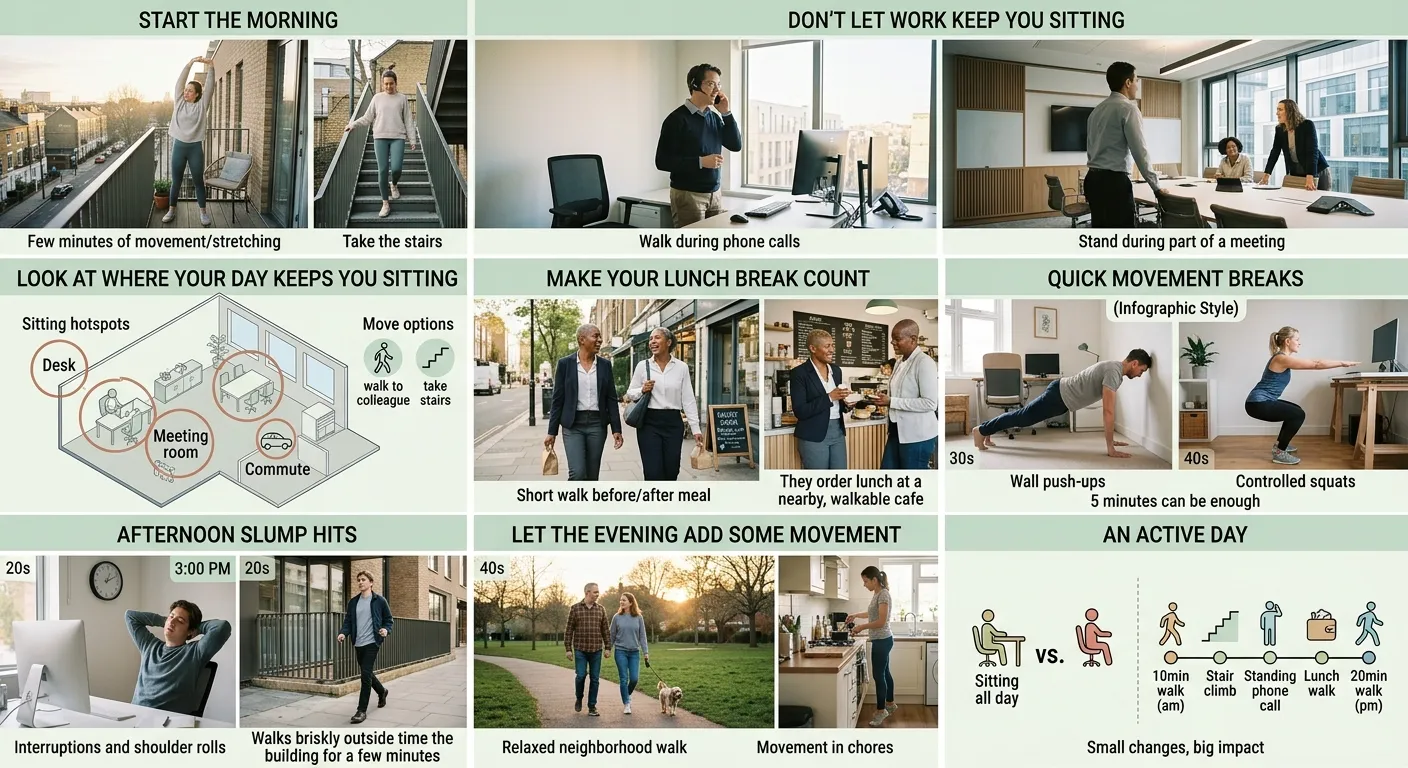
If you've been sitting all day, keep moving outside the workout too
An evening workout is helpful, but it doesn't turn an otherwise inactive day into an active one by itself.
If your job involves sitting for long periods, small opportunities to move can matter as part of the bigger picture.
Get up during breaks. Walk when you have a natural reason to do so. Take the stairs when that makes sense. Walk around while making a phone call if it's practical.
None of these needs to become another fitness assignment.
They're simply ways of breaking up long stretches of sitting.
Then your evening workout becomes one part of the day rather than the single moment when you're expected to compensate for everything that happened before it.
When rest is the better choice
Exercise is a stress on the body. Recovery is part of training, not evidence that you've failed to train.
If you're dealing with an illness, significant pain, unusual fatigue, or an injury, the answer isn't always to push through.
Even experienced exercisers have days when reducing the workload makes sense.
Persistent or significant pain deserves attention rather than being treated as something to ignore. If you have a medical condition, an injury, or a health concern that affects exercise, individualized guidance from an appropriate healthcare professional is more useful than a generic workout rule.
The aim is to build a routine that supports your health, not one that makes you feel guilty whenever your body asks for a break.
What could a week actually look like?
There's no need for every week to look identical, but having a rough idea can make exercise easier to fit around work.
For example, someone might strength train twice during the workweek, take a couple of walks, and use another evening for cardio or a recreational activity. The weekend might provide more time for a longer session or simply more opportunities to be active.
Another person might prefer three shorter sessions and more walking.
Someone training for a particular sport or event would likely need a much more specific schedule.
The point is that there isn't a magic Monday-to-Friday arrangement.
A good week is one that gives you enough movement to support your goals while leaving enough room for work, sleep, recovery, and everything else that makes up your life.
Make the evening transition easier
Sometimes the smallest part of the routine is the one that makes the biggest difference.
You finish work.
What happens next?
If the answer is always, “I'll sit down for a few minutes,” you already know how that story can end.
Perhaps changing clothes immediately works better. Perhaps you take a short walk before dinner. Maybe you go directly from work to the gym because once you're home, you know you won't want to leave again.
There are no prizes for choosing the most disciplined-looking option.
Choose the one that removes the most friction from your own day.
And don't be afraid to change it. A routine that worked six months ago may stop making sense when your work schedule changes.
There's no prize for making exercise harder than it needs to be
After-work exercise doesn't have to become another source of pressure.
Some days you'll have the energy for a proper training session. Other days, a walk will be enough. Once in a while, rest will be the sensible option.
That's normal.
The value of an exercise routine comes from what you can keep doing over time, not from how impressive a single Tuesday evening looks.
If your workday leaves you tired, build around that reality. If you enjoy the gym, use it. If walking is easier, walk. If short home workouts fit your schedule better, there's nothing inferior about choosing them.
The best evening routine is rarely the most elaborate one.
It's the one that still feels possible when the workday hasn't gone according to plan.