A busy day has a funny way of disappearing.
You wake up, get ready, have breakfast, commute to work, sit at a desk for hours, drive home, eat dinner, and suddenly it's bedtime. Somewhere along the way, you realize you spent most of the day sitting.
Maybe you planned to exercise. Maybe you even told yourself you'd find an hour later.
Then later came, and there wasn't an hour.
That is where exercises throughout the day can make a real difference. You don't always need a long workout to become more active. A walk before lunch, a few squats while you're waiting for the kettle, a trip up the stairs, or a short stretch between tasks can give your body a reason to move.
The point isn't to turn every spare moment into exercise.
It's much simpler than that.
Build a day in which sitting isn't the only thing you do.
For adults, current physical activity guidelines recommend 150–300 minutes of moderate-intensity aerobic activity each week, or 75–150 minutes of vigorous activity, along with muscle-strengthening activity on at least two days each week. You can spread that activity across the week rather than trying to fit everything into one long session.
That makes the idea much less intimidating, especially when your schedule is already full.
You Don't Need an Hour to Be More Active
Think about how many small gaps appear during a normal day.
There's the few minutes before breakfast. Time spent waiting for coffee. A break between meetings. The walk to the bathroom. Lunch. A phone call. The trip to the shop. The time after dinner when you're deciding whether to sit down and scroll through your phone.
None of these moments looks like a workout.
That's fine.
They don't need to.
Exercises throughout the day simply means taking advantage of some of these moments instead of waiting for a perfect block of free time.
Someone working from home might walk around the house during a phone call, take a short walk at lunch, stretch after several hours at the computer, and do some strength exercises in the evening.
Someone working in an office might take the stairs, walk to a colleague's desk, leave the building during lunch, or spend a few minutes walking before getting back to work.
The activities can look completely different from one person to another.
What matters is that movement becomes part of the day.
Look at Where Your Day Keeps You Sitting
The first useful question isn't, “Which exercise should I do?”
It's:
Where do I spend too much time sitting?
Maybe it's your commute. Maybe it's your desk. Maybe you sit through long meetings. Perhaps you spend the evening on the sofa because you're tired from work.
Once you notice the pattern, small changes become easier to find.
You don't have to redesign your entire routine.
If you normally drive to a nearby shop, walking there might be an option. If you usually send a message to someone who works down the hall, walking over might take only a few minutes. If you spend an hour talking on the phone, perhaps some of that conversation can happen while you're on your feet.
These aren't dramatic fitness decisions.
They're ordinary choices that happen to involve more movement.
And when you repeat ordinary choices often enough, they can become habits.
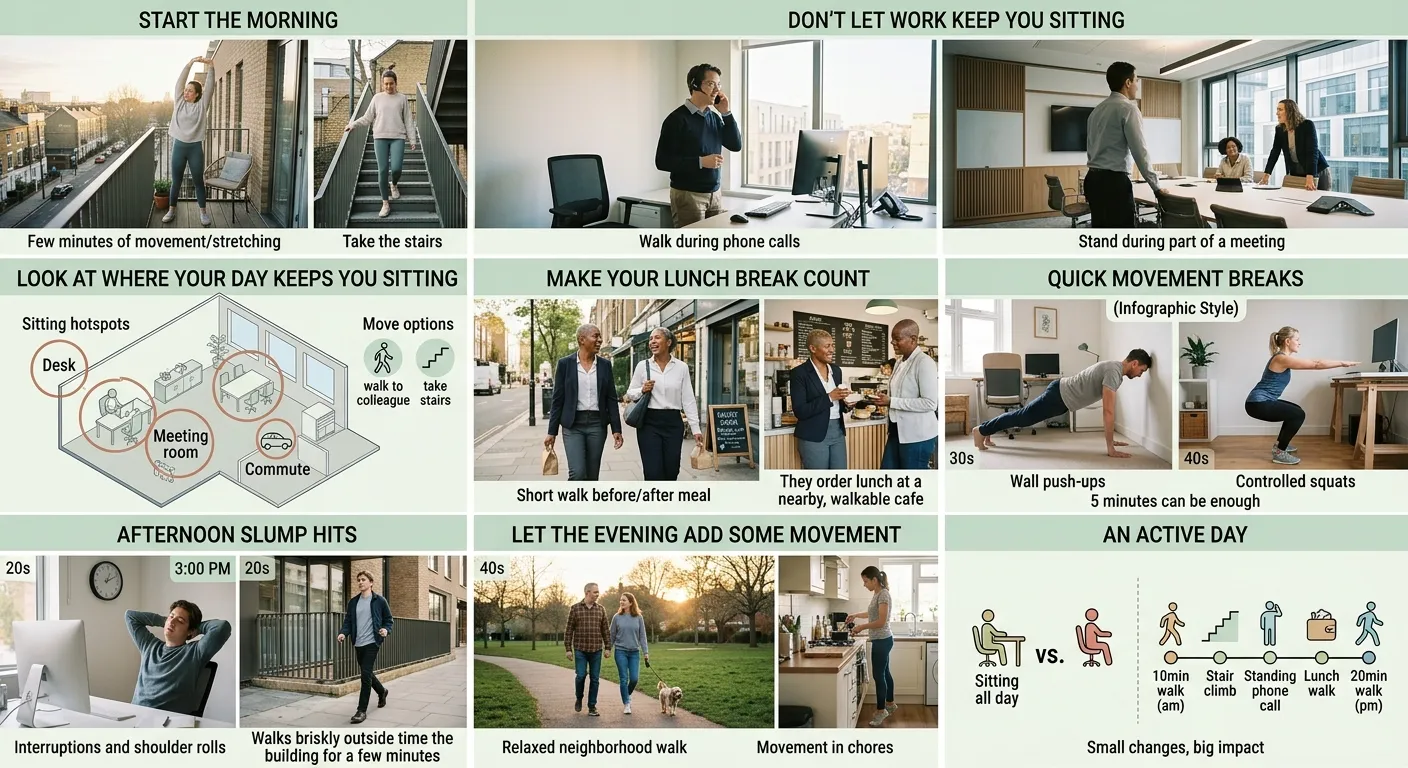
Start the Morning With a Little Movement
Your morning doesn't have to begin with a hard workout.
For some people, a few minutes of movement is enough to wake the body up after a night of sleep. You might walk around the house, take the stairs, do some gentle mobility work, or step outside for a short walk.
A simple morning might include a few bodyweight squats, calf raises, shoulder movements and several minutes of walking.
Keep it comfortable.
If you wake up feeling stiff, there is no need to immediately start jumping or doing difficult exercises. Give yourself a little time to move.
Your commute can provide another opportunity.
If you use public transportation, you might walk part of the route when practical. If you drive, parking a little farther away can add a few extra steps. Taking stairs instead of an escalator is another small choice when the stairs are appropriate for you.
One extra trip up the stairs won't transform your fitness.
Doing it regularly is a different story.
Don't Let Work Keep You in the Same Chair All Day
Desk work can swallow hours without making a sound.
You start answering emails. You work on a report. You join a meeting. You look at the clock and realize you've barely moved.
If that sounds familiar, don't wait until the end of the workday to fix it.
Look for natural reasons to get up.
Walk during a phone call if you can. Stand during part of a meeting when appropriate. Get some water. Walk to speak with a colleague. Take a short trip outside between tasks. Even getting up and changing position after sitting for a long stretch can give you a useful break from the same posture.
You don't need an elaborate office exercise routine.
Sometimes the best thing you can do is simply stop sitting.
That doesn't replace a proper workout, but it can make the working day much less static.
A Few Minutes Can Be Enough for a Quick Movement Break
When you only have a few minutes, choose something simple.
You don't need to change clothes or clear half the room.
Bodyweight squats
Stand with your feet in a comfortable position. Lower your body under control and then stand back up.
If a full squat feels uncomfortable, reduce the depth or use a stable support. The movement should suit your current ability rather than someone else's.
Wall push-ups
Wall push-ups are a convenient option when floor exercises aren't practical.
Place your hands against a wall, lean your body toward it, and push yourself away again. Moving your feet farther from the wall can make the exercise harder.
Calf raises
Stand tall and slowly rise onto the balls of your feet. Pause for a moment, then lower your heels.
If you feel unsteady, hold a sturdy surface.
Marching in place
A few minutes of marching can get your legs moving without requiring much space.
You can do it at home, in a private office, or almost anywhere you have enough room to move safely.
Shoulder movements
After sitting at a computer, your shoulders may appreciate a change of position.
Try gentle shoulder rolls, arm movements or other comfortable mobility exercises. Don't force the range of motion, especially if something hurts.
The best movement break isn't necessarily the hardest one.
It's the one you're actually willing to take.
Make Your Lunch Break Count
Lunch is an easy place to add movement because you already have a break built into your day.
Instead of eating at your desk and immediately returning to work, take a short walk before or after your meal.
Ten minutes is still ten minutes.
If you have more time, walk somewhere for lunch. If a nearby café or shop is within a comfortable walking distance, you may not need to drive.
There is something useful about attaching movement to an activity you already planned to do.
You don't have to think, “Now I must exercise.”
You're simply going somewhere.
The extra movement comes along with it.
When the Afternoon Slump Hits, Get on Your Feet
The afternoon can be the hardest part of a desk-bound day.
Your concentration starts to fade. Your back feels stiff. You've been looking at the same screen for hours.
Before reaching for another cup of coffee, try moving for a few minutes.
Walk around the building. Go outside. Take the stairs if they're suitable for you. Stand up and move your shoulders. Walk while thinking through a problem.
It doesn't have to be intense.
In fact, making the break too demanding may leave you more tired than you were before.
Think of it as an interruption.
You've been sitting for a long time. Now you're giving your body a few minutes of something different.
Let the Evening Add Some Movement Too
The evening doesn't have to become another demanding part of your schedule.
There is already plenty of movement hiding in ordinary activities.
Cooking. Cleaning. Gardening. Shopping. Walking the dog. Playing with your children. Carrying groceries.
All of these involve physical activity to some degree.
A walk after dinner can be especially easy to maintain. You don't need special equipment, and you can make it as relaxed or brisk as your ability and goals allow.
For someone who spends most of the day indoors, the change of scenery may be just as welcome as the movement.
Sometimes a twenty-minute walk around the neighborhood feels far easier than convincing yourself to start a complicated workout at 8 p.m.
What an Active Day Might Actually Look Like
Imagine someone who works at a desk and has very little spare time.
They don't suddenly discover a free two-hour window.
Instead, they make a few small changes.
In the morning, they walk for ten minutes.
During work, they get up between longer tasks and walk around instead of remaining at the desk.
At lunch, they take a 10–15 minute walk.
In the afternoon, they spend a few minutes moving after another long stretch of computer work.
After dinner, they walk for twenty minutes.
Twice during the week, they also make time for a structured strength session.
Nothing about that day looks extreme.
That's the point.
A physically active lifestyle doesn't have to look like a fitness influencer's schedule. It can look like an ordinary person making slightly different choices throughout an ordinary day.
How Much Movement Do You Really Need?
The numbers are useful, but they shouldn't make exercise feel like a pass-or-fail test.
For most adults aged 18–64, the World Health Organization recommends 150–300 minutes of moderate-intensity aerobic activity each week, or 75–150 minutes of vigorous activity, or an equivalent combination.
Adults should also do muscle-strengthening activities that work the major muscle groups on at least two days each week.
Those are weekly recommendations.
You don't have to complete them in one sitting.
You might prefer three longer walks. Someone else might take several shorter walks throughout the week. Another person might combine cycling, brisk walking and strength training.
There isn't one perfect schedule.
And if you're currently doing very little activity, you don't have to start at the full recommendation tomorrow morning. Beginning with smaller amounts and gradually doing more can be a much more realistic approach.
Some movement is better than none.
That is a useful place to begin.
Short Bursts Have a Place, but They Aren't Everything
A five-minute walk and a 45-minute workout aren't interchangeable.
They simply serve different purposes.
A short walk can break up a long period of sitting. A few squats can add some resistance work. A brisk walk can contribute to your weekly aerobic activity. A structured strength session can give your muscles a more deliberate challenge.
Think of these activities as pieces of the same picture.
If you move frequently during the day but never do strength training, adding some resistance work could make sense.
If you strength train regularly but spend the rest of the day sitting for ten hours, finding more opportunities to walk can still be worthwhile.
One type of activity doesn't have to compete with another.
They can work together.
Keep Some Strength Work in Your Week
Walking is an excellent starting point, but walking alone doesn't cover every aspect of fitness.
Strength work matters too.
You can use your body weight, resistance bands, dumbbells, gym machines or other forms of resistance. What matters is giving your muscles a reason to work against resistance.
A simple full-body session might involve a leg exercise such as a squat, a pushing movement such as a push-up, a pulling exercise with a resistance band, a hip-focused movement, some core work and another upper-body exercise.
You don't need a complicated program to begin.
The exercises should match your experience and physical ability. As you become stronger, you can gradually increase the challenge.
That is different from simply trying to move as much as possible every day.
Why Walking Is Such an Easy Starting Point
Walking fits into almost everything.
You can do it alone or with someone. You can walk before work, after dinner, during a phone call, on your commute or while running an errand.
You also don't need much equipment.
A brisk walk can count as moderate-intensity activity depending on the pace and the individual. For someone who isn't currently active, that can make walking a comfortable place to start.
And walking doesn't have to remain the only thing you do.
As your fitness improves, you may want to cycle, swim, run, lift weights, attend classes or try another activity you enjoy.
The best starting exercise is often the one that doesn't feel impossible to repeat.
Don't Turn Every Free Minute Into a Workout
There is a trap here.
Once you start thinking about movement throughout the day, you might feel that every spare minute should become an opportunity to exercise.
It doesn't.
You can sit down.
You can rest.
You can watch a movie without doing squats during every commercial break.
The purpose of adding movement isn't to make you feel guilty whenever you're still. It's to make prolonged inactivity less dominant in your day.
That distinction matters.
Exercise should fit into your life. Your entire life doesn't need to revolve around exercise.
What Can You Do If You Only Have Five Minutes?
Quite a lot, depending on what you want from those five minutes.
You could walk around the building. March in place. Climb stairs at a comfortable pace. Do several controlled squats and wall push-ups. Or simply stand up and move your body after sitting for a long time.
Five minutes won't suddenly transform your fitness.
But it can interrupt five more minutes of sitting.
And when those little choices happen repeatedly, they can change your overall activity pattern.
You may also notice something else.
Once movement becomes normal, starting a longer workout can feel less difficult because you no longer associate physical activity with having to find a perfect block of time.
Make Movement Part of Things You Already Do
You don't have to depend on motivation all day.
Instead, connect movement to things that already happen.
After a phone call, walk for a couple of minutes.
After finishing a major task, stand up.
Before lunch, go outside.
After dinner, take a walk.
While you're waiting for the kettle to boil, do a few calf raises.
These little connections can become automatic.
The environment can help too. Keep your walking shoes somewhere easy to reach. If practical, choose the stairs. Walk to nearby destinations instead of automatically driving. Avoid arranging your workspace so that everything you need sits within arm's reach.
None of these changes is revolutionary.
That's exactly why they can work.
Working From Home? Create Reasons to Get Up
Working from home removes some of the movement that naturally happens in an office.
There may be no commute. No walk to a meeting room. No trip to another floor. You might have your computer, coffee, water and everything else you need sitting within arm's reach.
That convenience can keep you in the same chair for hours.
Try creating a little separation.
Take a short walk before work begins. Move around during phone calls. Leave the house during lunch if you can. Get up between tasks rather than waiting until you're finished with everything.
A standing desk can also be useful for changing position, but standing still for hours isn't the same as moving.
Give your body some variety.
Sit. Stand. Walk. Stretch. Change position.
When Small Movement Isn't the Whole Answer
There are times when a more structured exercise plan makes sense.
Maybe you want to build noticeable strength. Perhaps you're training for a race, improving your mobility, preparing for a sport or working toward a specific fitness goal.
In those cases, random five-minute movement breaks won't provide enough structure on their own.
You may need to think about resistance, repetitions, recovery, progression and exercise selection.
That doesn't make the small movements pointless.
Think of them as the activity surrounding your main training.
Your workout might last an hour. The rest of your day still contains another 23 hours.
How you spend those hours matters too.
Listen to Your Body
More movement isn't always better simply because it's more.
If an exercise causes sharp, unusual or worsening pain, stop rather than trying to push through it.
You may also need to modify an exercise because of an injury, health condition, mobility limitation or lack of experience. People with chronic health conditions or disabilities can often benefit from physical activity, but the appropriate type and amount may vary.
If you're unsure about starting a demanding exercise program, especially after a long period of inactivity, speaking with a qualified health professional can help you choose an appropriate starting point.
There is no benefit in making your first week so difficult that you don't want to continue.
An Active Day Doesn't Have to Look Impressive
An active day may not look impressive from the outside.
You might walk instead of driving somewhere nearby. Take the stairs. Stand up several times while working. Walk after lunch. Do a short strength session. Take a relaxed walk after dinner.
None of those things sounds dramatic.
Together, they create a different kind of day.
That's the real appeal of exercises throughout the day. They take physical activity out of the narrow idea that exercise only counts when you're wearing workout clothes and following a formal routine.
You can move in the morning.
You can walk at lunch.
You can stretch between tasks.
You can take the stairs.
You can train your muscles later.
You can walk after dinner.
The day itself can give you plenty of chances to be active.
Start With Three Small Changes Tomorrow
Don't try to rebuild your entire routine overnight.
Choose three moments that already exist in your day.
Maybe you'll walk for ten minutes in the morning. Perhaps you'll get up during your work breaks. Maybe you'll take a short walk after dinner.
Do those things until they stop feeling like extra work.
Then, if you want to do more, add another habit.
You don't need a perfect schedule. You don't need to turn every break into a workout. And you certainly don't need to feel guilty about the moments when you sit and rest.
The aim is simply to make movement easier to find.
For some people, a healthier routine won't begin with an hour at the gym.
It will begin with getting out of the chair.
Then taking a few steps.
And doing it again tomorrow.
