When your knees hurt, even ordinary exercise can become a guessing game. A run that used to feel routine may leave you uncomfortable, and movements such as squats or stairs can suddenly seem much harder than they used to.
That doesn't mean exercise has to disappear from your routine.
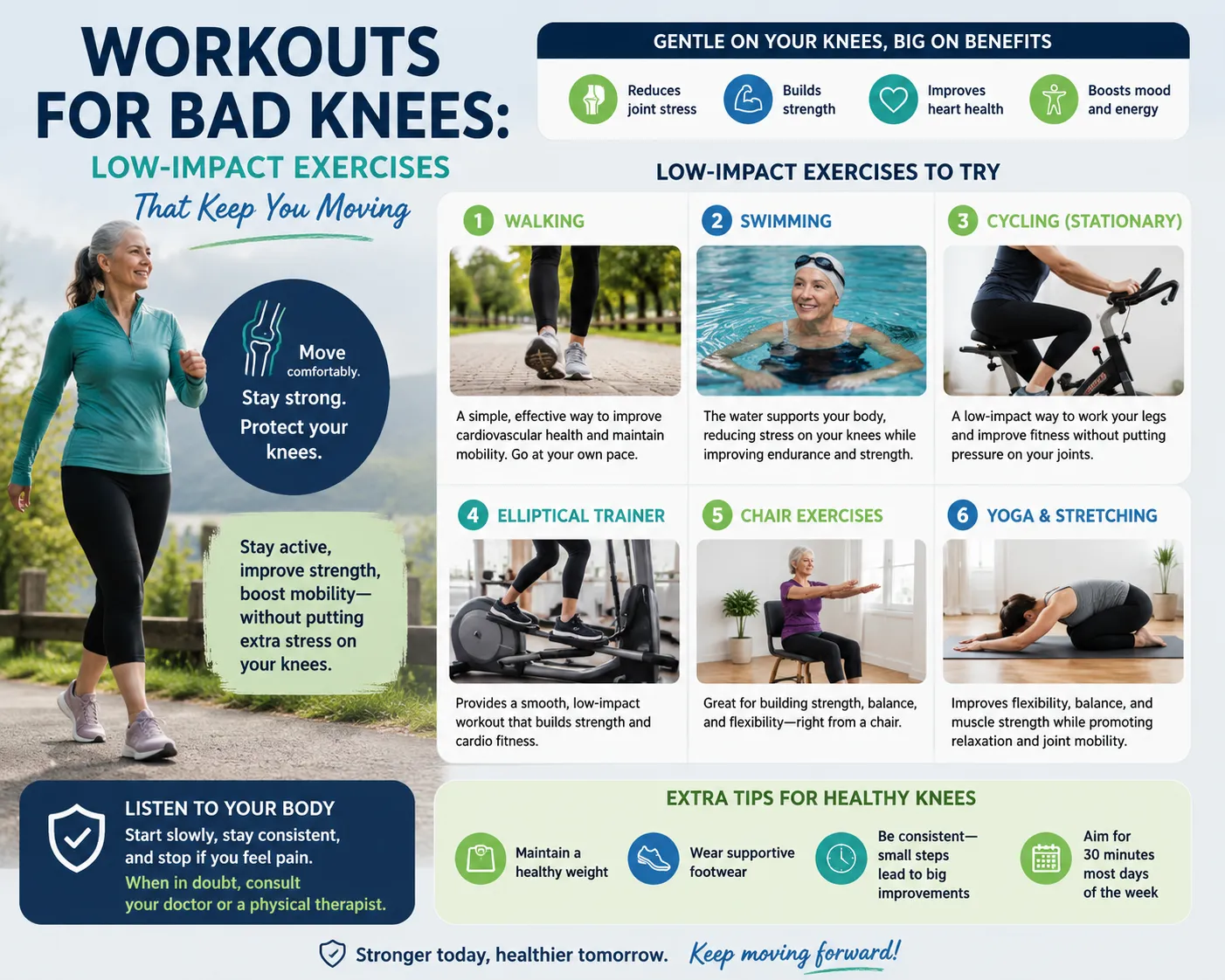
In many cases, the answer is to change the way you train. Walking, cycling, swimming, strength exercises, and gentle mobility work can offer ways to stay active without relying so heavily on jumping, running, or repeated hard landings. Physical activity can also improve pain and physical function in people with arthritis.
There's an important qualification, though: “bad knees” isn't a medical diagnosis. Knee pain has many possible causes, from arthritis and previous injuries to tendon problems and other conditions. The exercise that feels comfortable for one person might aggravate another person's symptoms.
So rather than searching for one perfect knee workout, it makes more sense to find movements that your knees handle well and build your routine around them.
What Makes an Exercise Easier on the Knees?
A knee-friendly workout isn't necessarily an easy workout. It can still challenge your muscles and raise your heart rate; the difference is that the activity places less repeated impact on the knees.
Cycling is a good example. Your legs work continuously, but you aren't repeatedly landing on the ground as you would while running or jumping. Swimming takes another route altogether, with the water supporting much of your body weight while you move.
Strength training deserves attention, too. The muscles around your hips and legs contribute to everyday movements such as standing, walking, and climbing stairs. Keeping those muscles strong can be useful, particularly for people managing knee osteoarthritis.
The best approach isn't identical for everyone. Your current fitness, symptoms, injury history, and the reason for your knee pain all influence which exercises make sense.
Walking Doesn't Have to Be Complicated
Walking is easy to overlook because it seems so ordinary.
Yet if your knees tolerate it, walking can be one of the simplest ways to stay active. A comfortable pace on a relatively flat surface may be enough to get started. You don't have to turn every walk into a workout that leaves you exhausted.
Someone who has been inactive for a while might prefer several short walks rather than one long outing. That's still meaningful movement, and physical activity can be broken into smaller periods throughout the day.
Pay attention to what happens afterward. If a certain distance repeatedly makes your symptoms worse, cutting the walk shorter or switching to another form of low-impact cardio may be a better choice.
Stationary Cycling
A stationary bike is useful when you want cardiovascular exercise without the repeated impact of running.
One advantage is control. Resistance can be changed, the pace can be adjusted, and you can stop easily if your knee isn't cooperating on a particular day.
There is no need to begin with heavy resistance. An easy ride that your knees tolerate is a more sensible starting point than a hard session followed by several days of discomfort.
As cycling becomes easier, either the duration or resistance can be increased gradually. Changing one thing at a time also makes it easier to notice how your knees respond.
The bike itself matters more than people sometimes realize. If your knee feels awkward throughout the pedal stroke, adjusting the seat or resistance may help. Persistent pain, however, is a reason to reconsider the exercise rather than simply pedaling through it.
Swimming and Water Walking
For some people, exercising in water feels noticeably different from exercising on land.
The water supports much of your body weight, so walking or moving through it can feel easier on sore joints. Swimming can provide cardiovascular exercise without the repeated impact of running, while water walking gives the legs resistance in a different way.
You don't have to be an experienced swimmer to use the pool. Water walking or a suitable aquatic exercise class may be enough.
The CDC includes swimming and water-based exercise among joint-friendly activities for people with arthritis.
Chair Sit-to-Stands
Standing up from a chair may not look like a conventional workout, but it closely resembles something your knees already do every day.
From a stable chair, rise to standing and then lower yourself back down in a controlled manner. The movement works the thighs and hips while giving you a chance to practice a familiar everyday action.
The height of the chair can change the difficulty. A higher seat may feel more comfortable if a low chair requires more knee bending than you can currently tolerate.
There's no need to force a deep squat here. A controlled movement through a comfortable range can be enough.
If your knee repeatedly gives way, locks, or becomes significantly painful during the exercise, stop rather than treating the symptom as something you simply have to work through.
Seated Knee Extensions
This is one of the simpler strengthening movements, and it can be done from a chair without much equipment.
Sit comfortably with your feet supported. Slowly straighten one leg through a comfortable range, then bring it back down before switching sides.
The quadriceps—the muscles at the front of the thigh—are doing much of the work. Strengthening these muscles is commonly included in exercise programs for people with knee problems, including knee osteoarthritis.
There is no need to add weight straight away. For someone just getting started, controlled body-weight movement may be plenty. If resistance is added later, it should still allow the movement to remain smooth.
A fast swinging motion isn't necessarily a more effective one. In this case, control matters more than speed.
Glute Bridges
Not every useful exercise for sore knees has to involve bending and straightening the knee repeatedly.
Glute bridges are performed on the floor and focus on the muscles around the hips and the back of the legs. That makes them a convenient option when standing exercises aren't comfortable.
Lie on your back with your knees bent and your feet resting on the floor. Lift your hips, pause briefly, and lower them again in a controlled manner.
The height of the bridge isn't the main goal. A smaller movement that feels comfortable can still give the muscles a useful challenge.
If the position bothers your knees or lower back, changing the setup or choosing another exercise may be more appropriate.
Side-Lying Leg Raises
Your hips deserve some attention in a lower-body workout, too.
Side-lying leg raises are performed on your side rather than standing, so the knees aren't supporting your body weight throughout the exercise. The movement is small: raise the upper leg under control and lower it without swinging.
It may look simple, but that doesn't mean the exercise has to be rushed. Keeping the movement steady makes it easier to focus on the muscles you're trying to work.
As with other exercises, there's little value in forcing a larger range if doing so makes the movement uncomfortable.
Resistance Bands Add More Options
Resistance bands can make a knee-friendly routine less repetitive without requiring a room full of gym equipment.
They can be used for hip and leg exercises, but they also work well for the upper body. That's worth remembering when knee pain is limiting your lower-body training. There is still plenty you can do for your back, shoulders, chest, and arms.
Choose a level of resistance that lets you move with control. If you find yourself jerking the band or twisting your body to complete a repetition, the exercise has probably become more difficult than it needs to be.
The CDC recognizes resistance bands as one option for muscle-strengthening activity, including for people with chronic health conditions or disabilities.
Gentle Mobility Has a Place, Too
A workout doesn't always have to involve strength or cardio.
Gentle movement through a comfortable range can be useful on days when a full workout isn't appealing. Depending on your situation, that might include easy knee movements, ankle circles, or comfortable hip mobility exercises.
The aim isn't to push a joint as far as it can possibly go. Mobility work should feel controlled rather than forced.
It can also be a useful way to keep moving between more demanding sessions.
Building a Week Around Your Knees
There's no single schedule that works for everyone.
A person who already exercises regularly may tolerate much more activity than someone who has been inactive for several months. The reason behind the knee pain matters as well.
For adults who are able, general guidelines call for at least 150 minutes of moderate aerobic activity per week, along with muscle-strengthening activity on two or more days. People with chronic health conditions are encouraged to be as active as their abilities allow.
Those numbers are a general target, not a starting line you have to reach immediately.
A week might look something like this:
- Monday: Easy walking or stationary cycling
- Tuesday: Strength work, such as sit-to-stands, bridges, and seated knee extensions
- Wednesday: Gentle mobility or rest
- Thursday: Swimming, water walking, or cycling
- Friday: Another strength session using body weight or resistance bands
- Saturday: A comfortable low-impact activity you enjoy
- Sunday: Rest or gentle movement
The schedule can be rearranged. Some people may prefer shorter sessions more often, while others may feel better with longer periods of activity separated by rest days.
The useful part is finding a rhythm that your knees and the rest of your body can handle.
What About Squats and Lunges?
Squats and lunges often get labeled as either “good” or “bad” for the knees. Reality is less tidy.
Neither movement is automatically inappropriate for everyone with knee pain. Depth, resistance, balance, technique, and the reason for the pain all change the equation.
For example, a deep squat might be uncomfortable while sitting down and standing up from a higher chair feels fine. Someone else may tolerate a supported lunge but struggle with an unsupported version.
That is why the question isn't simply, “Are squats bad for my knees?” A better question is whether a particular version of the movement fits your current ability.
If a movement repeatedly causes significant pain or swelling, though, it deserves a closer look rather than being forced into the routine.
Which Exercises Might Be More Difficult?
Running and jumping create more impact than activities such as cycling or swimming. When your knees are already irritated, repeated jumping, jump squats, jumping lunges, and hard landings may be difficult to tolerate.
Still, it's worth avoiding blanket statements.
A person recovering from an injury may eventually return to running or jumping with an appropriate progression. Someone with a different knee problem may have different restrictions. Temporarily choosing a lower-impact activity doesn't necessarily mean you'll never return to higher-impact exercise.
If you're currently experiencing knee pain, replacing running with cycling or swimming can be one way to maintain cardiovascular activity while reducing impact. NHS guidance advises against running with knee pain and recommends medical advice when symptoms persist.
How Should You Judge Your Response to Exercise?
Exercise isn't always completely sensation-free, particularly when you're becoming active again.
Some people with arthritis experience temporary stiffness or discomfort when they increase their activity. What matters is the pattern rather than one isolated sensation during a workout.
Suppose your knee feels mildly tired after cycling and settles normally. That's a different situation from pain that keeps increasing each time you train or swelling that lingers after exercise.
A change in symptoms can be useful information. Perhaps the workout was too long. Maybe the resistance was too high, or the movement itself isn't a good fit right now.
Severe pain, substantial swelling, instability, locking, or difficulty bearing weight are different matters. Those symptoms deserve attention rather than being treated as ordinary workout discomfort.
Common Mistakes to Avoid
Doing too much because you finally feel good
A workout that feels comfortable can create a strong temptation to do more.
If you've been inactive, however, a sudden jump in training volume may leave your knees unhappy even if the exercise itself seemed suitable. Gradual increases make it easier to find your limits without constantly overshooting them.
Avoiding movement altogether
When a joint hurts, complete rest can seem like the obvious solution.
Sometimes reducing activity is appropriate, especially after certain injuries. But long-term avoidance isn't necessarily helpful for many joint conditions. Appropriate physical activity can be part of maintaining strength and function.
The challenge is finding an amount and type of movement that works for you.
Making every workout about calories
A difficult workout isn't automatically a better workout.
Someone with knee pain might get far more value from a moderate cycling session they can repeat regularly than from an intense jumping workout that causes several days of discomfort.
Exercise has to fit into real life. If the only way to complete a workout is to recover from it for the next few days, it may be time to rethink the workout itself.
Trying to prove you can tolerate pain
There is a difference between muscles working hard and a painful joint.
Pushing through every uncomfortable sensation isn't a badge of fitness. If knee pain is severe, getting worse, or accompanied by swelling or instability, it's worth stepping back and finding out why.
When Is Professional Advice a Good Idea?
An exercise article can suggest possibilities, but it can't tell you what's causing your knee pain.
If symptoms keep coming back, interfere with everyday activities, disturb your sleep, or fail to improve, a doctor or physiotherapist can help determine what is happening.
Professional assessment is particularly important after an injury or when you have severe pain, major swelling, difficulty putting weight on the leg, a changed knee shape, locking, repeated giving way, or a hot and red knee accompanied by fever or feeling unwell. NHS guidance recommends urgent assessment for symptoms of this kind.
A physical therapist can also make exercise more specific to your situation. Rather than handing you a generic list, they can consider your strength, mobility, symptoms, and movement patterns when deciding what to work on and how to progress.
Frequently Asked Questions
Is walking good for bad knees?
Walking can be a useful low-impact activity when your knees tolerate it. Starting with a comfortable amount and gradually increasing your activity may be easier than immediately attempting long walks. The CDC includes walking among joint-friendly activities for people with arthritis.
Is cycling better than running for knee pain?
Cycling generally involves less impact than running, so some people with knee pain find it more comfortable. But that doesn't make it universally better. Your symptoms and the reason for your knee pain still matter.
Can strength training help painful knees?
Strength training can form part of an exercise program for knee osteoarthritis and other knee problems. Exercises may focus on the thighs, hips, and other muscles involved in lower-body movement, although the most appropriate choices depend on the individual.
Should I exercise when my knee hurts?
Knee discomfort doesn't automatically mean you have to stop every form of movement. However, severe, persistent, or worsening pain shouldn't simply be ignored. If you're unsure what's causing the problem, professional advice is safer than trying to diagnose it yourself.
Are squats bad for your knees?
Not necessarily. Squats can be changed by adjusting their depth, resistance, range of motion, or support. Whether they're appropriate depends on the individual and the reason for the knee symptoms.
What is the best cardio for bad knees?
There isn't one answer that works for everyone. Walking, cycling, swimming, water walking, and other low-impact activities can all have a place in a fitness routine. The best option is generally one that fits your abilities and doesn't repeatedly aggravate your symptoms.
Keeping Exercise in Your Life
Knee pain may change the way you exercise, but it doesn't automatically have to end your workouts.
Running might give way to cycling for a while. A deep squat might become a chair-supported movement. A long walk could turn into several shorter ones. Spending time in the pool might simply feel better than exercising on land.
Those adjustments aren't a sign that you're doing less with your fitness. They're ways of working with the body you have right now.
The most useful workouts for bad knees are the ones that give you a realistic way to stay active without continually making your symptoms worse. A combination of manageable cardio, sensible strength work, and comfortable mobility can provide plenty of variety. And when knee pain is persistent, severe, or difficult to understand, getting professional guidance is far more useful than trying to push through it.