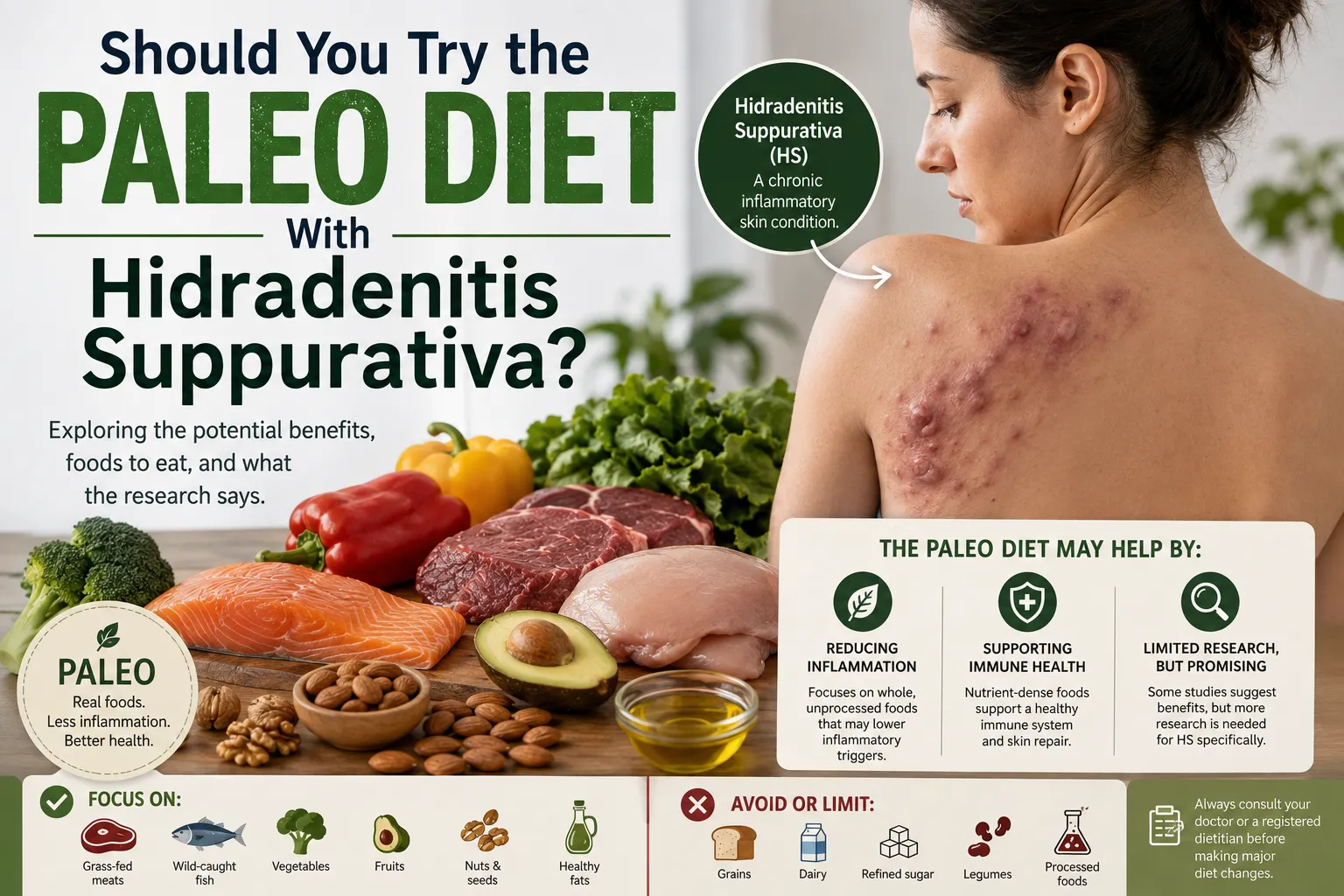
When you have hidradenitis suppurativa (HS), it’s easy to start wondering whether food has something to do with your flare-ups. Maybe you’ve noticed that certain meals seem to coincide with worse symptoms. Or perhaps you’ve read about people who changed their diet and felt that their skin improved.
That makes the Paleo diet an interesting option to consider.
But should you try the Paleo diet with hidradenitis suppurativa?
There isn't enough evidence to say that Paleo treats HS, and it certainly isn't a proven cure. Still, some of the foods it emphasizes—and some of the foods it removes—overlap with dietary changes researchers have been studying in people with HS.
So rather than treating Paleo as an all-or-nothing solution, it may be more helpful to look at what the diet actually changes, what research says about those changes, and whether a restrictive eating pattern makes sense for you.
First, what exactly is hidradenitis suppurativa?
Hidradenitis suppurativa is a chronic inflammatory skin condition that usually appears in places where skin rubs together, including the underarms, groin, buttocks, and the area beneath the breasts. It can cause painful recurring lumps, drainage, scarring, and tunnels beneath the skin.
HS isn't simply a reaction to something you ate. It is a complicated condition influenced by multiple factors, and symptoms can vary considerably from one person to another.
Diet has nevertheless become an area of interest. HS has been associated with metabolic health and, in some people, obesity and insulin resistance. Researchers have also been looking at whether dietary patterns influence disease activity.
The catch is that much of the research is still based on small studies or observational data. A connection between a dietary pattern and HS doesn't automatically mean that the diet caused the improvement.
That distinction becomes especially important when evaluating popular diets online, where personal success stories can sound much more conclusive than the research really is.
What happens when you go Paleo?
A typical Paleo eating pattern centers on foods such as vegetables, fruit, meat, poultry, fish, eggs, nuts, and seeds. Highly processed foods and added sugars are generally reduced, while grains, legumes, and dairy are usually excluded or heavily restricted.
There isn't one perfectly standardized version of Paleo, so the exact rules can vary.
That variation also makes the diet difficult to study as a single treatment. Someone who says Paleo helped their HS may have changed several things at the same time. They may be eating more vegetables, cutting back on sugary drinks, eating fewer processed foods, avoiding dairy, or experiencing a change in weight.
Which of those changes mattered?
It may be impossible to tell from the diet label alone.
What does the research say about Paleo and HS?
This is where the answer becomes less exciting—but more useful.
There isn't currently strong clinical evidence showing that the Paleo diet itself improves hidradenitis suppurativa.
Researchers have investigated a range of dietary approaches, including elimination diets and changes involving dairy, brewer's yeast, sugar, and other foods. Reviews of this research suggest that diet may influence HS for some people, but the evidence is still limited and stronger studies are needed.
More recent research has continued to explore links between HS, dietary patterns, metabolic health, and nutritional status. Some findings are interesting, but they don't give us a single diet that can be recommended to everyone with HS.
In other words, Paleo is worth discussing as an option, but it shouldn't be presented as an established treatment.
Why might Paleo appear to help?
Imagine someone whose usual meals include plenty of fast food, sweetened drinks, packaged snacks, and refined carbohydrates. They start eating Paleo and replace much of that with vegetables, fruit, fish, eggs, meat, nuts, and other minimally processed foods.
A few weeks or months later, they notice their HS seems better.
That experience is real from their perspective, but it doesn't tell us exactly why the change happened.
Perhaps reducing added sugar mattered. Maybe the overall shift toward less processed food played a role. Weight or metabolic changes could also be relevant. And because HS naturally changes over time, some improvement may have happened independently of the diet.
This is why personal observations are worth paying attention to without treating them as proof.
Could dairy be a factor?
Dairy is one of the more interesting pieces of the HS diet conversation.
Traditional Paleo excludes milk, cheese, yogurt, and other dairy products. Some small studies have also looked at dairy elimination in people with HS and reported possible improvements.
The evidence, however, isn't strong enough to say that dairy causes HS or that everyone with the condition should stop consuming it.
The American Academy of Dermatology mentions the same area of research, noting that one small study found fewer HS flares after participants stopped consuming dairy. At the same time, the organization emphasizes that there is no single proven HS diet.
That leaves an important middle ground.
If you tolerate dairy without noticing any consistent change in your symptoms, there may be no reason to assume it is a problem. If you've repeatedly noticed that your symptoms seem different after eating certain dairy products, that pattern is something you can bring to a dermatologist or dietitian.
What about sugar?
Paleo also removes or sharply reduces many foods high in added sugar, which is another reason the diet has attracted attention in the HS community.
Researchers have been interested in the possible relationship between high-glycemic eating patterns and HS. Some evidence points toward an association, but it isn't strong enough to conclude that everyone with HS needs to follow a completely sugar-free diet.
There's a useful distinction here.
Reducing added sugar is not the same as avoiding every carbohydrate. A piece of fruit, a serving of beans, and a sugary soft drink all contain carbohydrates, but they aren't nutritionally interchangeable.
That matters because an eating pattern can become unnecessarily restrictive when broad food categories are treated as though they're all the same.
Does weight loss affect HS?
Weight is another subject that comes up frequently in conversations about HS.
Studies have found that significant weight loss may be associated with improvements in HS severity among people who are overweight or obese. A systematic review found evidence pointing in that direction, although the researchers also noted limitations in the quality of the available studies.
The American Academy of Dermatology also discusses weight loss as a possible factor in improving HS for some people who are overweight or obese.
That doesn't make body weight the explanation for HS.
People with HS have different body types, and the condition can't be reduced to a weight problem. If weight management happens to be relevant to your overall health, a sustainable eating pattern is generally more useful than choosing a diet simply because it promises dramatic restrictions.
Is Paleo better than the Mediterranean diet?
If you're looking at dietary patterns rather than individual foods, the Mediterranean diet deserves a place in the conversation.
Mediterranean-style eating typically includes plenty of vegetables, fruit, whole grains, beans, fish, seafood, nuts, and olive oil. Highly processed foods and excess added sugar tend to play a smaller role.
Some research has found that lower adherence to a Mediterranean-style diet is associated with greater HS severity. Again, that doesn't prove the diet prevents or treats HS, but it has given researchers a reason to investigate the relationship further.
Paleo and Mediterranean eating also differ in an important way: Paleo usually removes grains and legumes, while Mediterranean eating can include both.
For someone who wants to eat more whole foods without eliminating large food groups, that flexibility may be appealing.
There's no need to turn this into a contest between two diet labels, though. The useful question is which eating pattern gives you nutritious food, enough variety, and something you can realistically maintain.
Do nightshades need to go?
Tomatoes, peppers, eggplant, and potatoes sometimes get blamed for inflammatory symptoms, and some elimination diets recommend avoiding them.
For HS, though, the evidence is not strong enough to recommend removing nightshades across the board. Dietary reviews have discussed nightshade avoidance, but research in this area remains limited.
This is a good example of how quickly an HS diet can become overly restrictive.
Suppose someone removes dairy, grains, legumes, nightshades, sugar, and several other foods at once. Their symptoms later change. There is no easy way to know which change mattered.
A narrower diet isn't automatically a better diet.
The downside of strict Paleo
Paleo can include many nutritious foods, but its restrictions are worth considering before making a major change.
Removing grains, legumes, and dairy means there are fewer foods to choose from. Whether that creates a nutritional problem depends largely on what replaces them.
A varied Paleo-style diet can still include plenty of vegetables, fruit, fish, eggs, meat, nuts, and seeds. A poorly planned version, however, can become repetitive or unnecessarily restrictive.
There's another issue that doesn't get as much attention: the relationship people have with food.
Research has found concerns about disordered eating behaviors among some people with HS. That doesn't mean a Paleo diet will cause a problem, but it does suggest that restrictive dietary advice deserves some care.
If a diet makes you afraid of ordinary foods, uncomfortable eating with other people, or constantly worried about whether you've broken a rule, that experience matters too.
Healthy eating isn't just about the list of foods that are allowed.
What could a Paleo-style meal look like?
There is no special Paleo meal that has been proven to prevent an HS flare. Still, it can help to picture what the eating pattern actually looks like.
You might have eggs alongside vegetables and fruit in the morning. Later, a salad with chicken, nuts, and a variety of vegetables could make up lunch. Dinner might be fish with roasted vegetables.
The common thread isn't a particular “HS food.” It's the emphasis on relatively simple, minimally processed ingredients.
That distinction keeps the focus where it belongs. These foods can be part of a nutritious diet, but they shouldn't be presented as medicines for HS.
What about vitamins and supplements?
Vitamin D and zinc are among the nutrients that have received attention in HS research. Some studies have explored nutrient levels and supplementation, but this area is still developing.
A nutrient being associated with HS doesn't automatically mean that taking more of it will improve your symptoms.
Supplements can also have risks when taken in inappropriate amounts. If you suspect a deficiency, talking with a doctor can help determine whether testing or supplementation makes sense.
The same principle applies to Paleo. Simply removing foods doesn't guarantee that your nutritional needs will be met. Variety still matters.
If you suspect a food trigger
It can be frustrating when you're trying to figure out whether food affects your HS. Changing everything at once usually makes that puzzle harder.
For example, if dairy, grains, legumes, sugar, and nightshades all disappear from your diet on the same day, an improvement later doesn't tell you which change was responsible.
A registered dietitian or other qualified healthcare professional can help you approach suspected food triggers in a more measured way, particularly if several food groups are involved.
A simple symptom and food record may also reveal patterns that aren't obvious from memory. At the same time, it's worth keeping perspective. HS can fluctuate, and a single flare after a particular meal doesn't necessarily mean that meal caused it.
Can diet replace medical treatment?
It can't.
Diet may be one part of managing HS, but there is no good evidence that Paleo can replace appropriate medical treatment.
HS can become persistent and may lead to scarring or tunnels beneath the skin. Depending on the person's symptoms and circumstances, treatment may involve medication, procedures, lifestyle changes, or a combination of approaches.
If your HS is becoming more painful, frequent, or difficult to manage, a dermatologist can help you look at treatment options. Changing your diet can be discussed alongside that care rather than used instead of it.
When strict Paleo may not make sense
There are plenty of reasons someone might decide that Paleo isn't the right fit.
Perhaps you enjoy foods such as whole grains and beans and don't want to give them up. Maybe eating with family or friends makes strict food rules inconvenient. For someone with a limited food budget, buying certain Paleo staples may also be less practical.
And if you've tried restrictive diets before and found that they make eating stressful, that's useful information.
You don't have to follow a diet perfectly for your eating habits to improve.
Sometimes the changes people are looking for from Paleo are much simpler: fewer sugary drinks, less highly processed food, more vegetables, and a greater emphasis on balanced meals.
Those choices don't require a Paleo label.
A better question to ask about HS and diet
Rather than searching for the perfect “HS diet,” it may be more helpful to look at the details of your own eating pattern.
Maybe most of your meals are already based on whole foods, but sugary drinks are a daily habit. Perhaps vegetables rarely make it onto your plate. You might eat a lot of dairy and have noticed a consistent relationship with your symptoms. Or maybe you've tried eliminating foods in the past and saw no meaningful change.
Those situations aren't interchangeable.
Current research doesn't support one universal diet for hidradenitis suppurativa. What it does suggest is that overall dietary quality, metabolic health, nutritional status, and certain individual dietary factors deserve continued research.
That uncertainty isn't a reason to ignore diet. It is a reason to approach dietary changes thoughtfully.
Questions worth discussing with a healthcare professional
If you're considering Paleo because of HS, a dermatologist or registered dietitian can help you think through the bigger picture.
You might ask whether eliminating particular foods makes sense for you, whether your current diet provides enough nutrients, and whether there are signs of a deficiency worth investigating. If weight or metabolic health is part of the picture, that can be discussed too.
It can also be useful to ask whether a less restrictive eating pattern, such as a Mediterranean-style approach, would give you similar nutritional advantages without eliminating as many foods.
The aim isn't to find the strictest diet you can tolerate. It's to understand what may be relevant to your health and avoid restrictions that don't have a clear purpose.
Frequently asked questions
Can the Paleo diet cure hidradenitis suppurativa?
No. There isn't enough evidence to say that Paleo cures HS. Some features of the diet overlap with dietary factors being studied, but Paleo itself has not been established as a treatment.
Is Paleo better than the Mediterranean diet for HS?
There isn't enough evidence to make that comparison. Mediterranean-style eating has received more research attention in connection with HS, but neither diet has been proven to work as a universal treatment.
Should everyone with HS stop eating dairy?
No. Some small studies suggest dairy elimination may help certain people, but that isn't enough evidence to recommend avoiding dairy for everyone.
Does sugar cause HS flares?
The possible relationship between high-glycemic eating patterns and HS is being studied, but there is no established rule that everyone with HS needs to eliminate sugar completely. Cutting back on added sugar can still be part of an overall nutritious eating pattern.
Does everyone with HS need to lose weight?
No. HS affects people with different body types. Weight loss may improve symptoms for some people who are overweight or obese, but it isn't a universal treatment or requirement.
Is there a single diet that works for everyone with HS?
No. Researchers have not identified one diet that consistently works for everyone with hidradenitis suppurativa. Individual factors, nutritional needs, metabolic health, and possible food triggers can all matter.
The bottom line
So, should you try the Paleo diet with hidradenitis suppurativa?
There isn't enough evidence to recommend Paleo as a treatment for HS. Some aspects of the diet—such as eating more vegetables and minimally processed foods and cutting back on added sugar—fit with areas researchers are studying. Dairy elimination is another possibility that has received some attention, although the evidence remains limited.
The bigger lesson is that you don't necessarily have to adopt a strict diet to make sensible changes.
A balanced eating pattern that provides enough nutrients and feels manageable in everyday life may be a better starting point than a long list of forbidden foods. If you suspect that a particular food is affecting your symptoms, a dermatologist or registered dietitian can help you explore that possibility without turning every meal into a test.
HS is complicated, and diet is only one piece of it. For now, the evidence supports curiosity and individualization more than a single set of Paleo rules.