When your knees aren't cooperating, cardio can become surprisingly complicated. Running hurts. Jumping doesn't feel much better. Even a long walk may leave you wondering whether you're helping your fitness or simply irritating the joint.
The good news is that getting your heart rate up doesn't require high-impact exercise. Cycling, swimming, water exercise, walking, and some other low-impact activities can provide useful cardiovascular exercise while reducing the repeated impact associated with running and jumping.
There is, however, an important catch: “bad knees” isn't a specific diagnosis. Knee discomfort can come from many different causes, and an activity that feels comfortable for one person may be a poor choice for someone else.
So rather than looking for a single perfect workout, it makes more sense to find movement that your knees handle reasonably well and that you can keep doing over time.
Why Low-Impact Cardio Can Be a Better Fit
Cardio doesn't have to involve pounding the pavement.
Aerobic exercise includes any sustained movement that challenges your heart and breathing. Walking, cycling, swimming, and water-based exercise can all serve that purpose, even though they feel very different from running.
The difference is often the amount of impact involved. With running and jumping, the feet repeatedly strike the ground. On a bike or in a pool, that repetitive impact is greatly reduced. The CDC includes walking, cycling, swimming, and water exercise among physical activities that can be easier on the joints, particularly for people with arthritis.
Still, “low impact” doesn't mean “guaranteed to feel good.”
A stationary bike may be comfortable for one knee and uncomfortable for another. The same is true of walking or an elliptical. The cause of the pain, the way the exercise is performed, and your current tolerance all matter.
That's why the label on the exercise is only part of the story. How your knee responds is more useful.
Cardio Options Worth Trying
There are several ways to get an aerobic workout without making running the centerpiece of your routine. Which one works best will depend on your knees, preferences, fitness level, and access to equipment.
Stationary Cycling
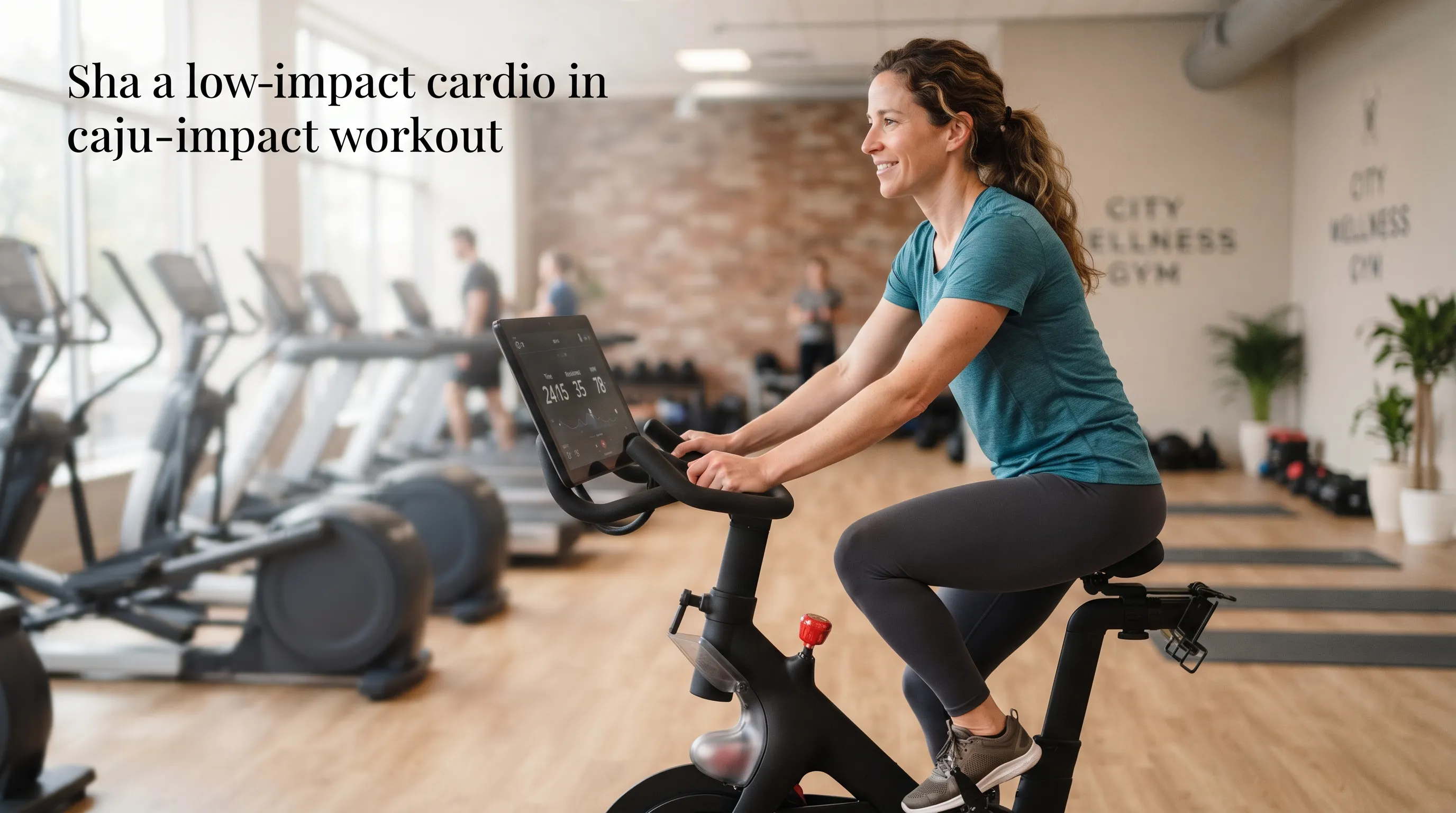
A stationary bike gives you a controlled way to exercise without repeatedly landing on your feet.
You can keep the resistance light when your knees are sensitive and increase the challenge later if the movement continues to feel comfortable. There's also no need to deal with traffic, weather, or uneven ground, which makes indoor cycling an easy option to fit into a regular routine.
Bike position can make a noticeable difference. If the seat is too low, your knee may bend more than feels comfortable. If pedaling causes pain even at an easy resistance, pushing through isn't likely to solve the problem. The setup may need changing, or another type of cardio may simply suit you better.
Some people prefer recumbent bikes because the seat provides more back support and changes the riding position.
Swimming
Swimming has an obvious advantage when weight-bearing exercise is uncomfortable: the water supports much of your body.
That can make moving around the pool easier than walking on land. Swimming also provides cardiovascular exercise without the repeated foot strikes associated with jogging.
The different strokes aren't identical, though. Kicking patterns and knee positions vary, so a stroke that feels fine for one swimmer might irritate another person's knee.
And if swimming laps isn't your thing, there's no requirement to make it your workout. Water exercise offers another route.
Water Aerobics
Water aerobics can be particularly appealing if you want the support of a pool without swimming continuously.
Moving through water creates resistance while also reducing the amount of body weight your joints have to support. The combination can make an exercise session feel more demanding than it looks.
The CDC recognizes water exercise as a joint-friendly activity, including for people with arthritis.
For someone who finds walking uncomfortable after a short period, exercising in the pool can feel completely different. The water changes the amount of loading on the knees, which is one reason aquatic exercise is often worth considering.
Walking
Walking doesn't require much equipment or planning, which is precisely why it remains such a useful form of cardio.
When your knees tolerate it, a brisk walk can raise your heart rate enough to count as moderate-intensity activity. The CDC includes brisk walking among examples of moderate physical activity and lists walking as a low-impact option for people with arthritis.
The surface can matter. A flat, even route may be easier to handle than a steep hill or rough trail, particularly when you're getting back into exercise.
You don't have to turn every walk into a long session, either. If your knee becomes uncomfortable after 10 or 15 minutes, shorter walks at different points in the day may be more manageable than insisting on one extended outing.
Elliptical Training
The elliptical occupies an interesting middle ground. The movement resembles walking or running, but your feet remain on the pedals rather than repeatedly hitting the floor.
For some people, that reduction in impact makes the machine comfortable. For others, the repeated knee bending is enough to cause trouble.
It's worth treating the elliptical as an option rather than an automatic solution. If the movement feels smooth and comfortable, it may work well. If your knee complains every time you use it, another form of cardio deserves a chance.
Seated and Upper-Body Cardio
Some gyms have machines that let you perform cardio while sitting or using more of the upper body.
These aren't necessary for most people, but they can be useful when putting weight through the legs is particularly uncomfortable. They also illustrate a broader point: cardiovascular exercise doesn't have to follow the traditional “run, jump, sweat” formula.
The right workout is the one that gives you a worthwhile challenge without creating problems you then have to spend days recovering from.
Is Running Off the Table?
Not necessarily.
Knee pain by itself doesn't tell you whether running is appropriate. Someone with occasional discomfort may have a very different situation from someone recovering from an injury or dealing with a diagnosed joint condition.
If running consistently makes your symptoms worse, though, there's little reason to force it simply because it's a familiar form of cardio.
The U.S. Physical Activity Guidelines note that walking generally has a lower injury risk than running and identify walking and bicycling among activities with relatively low injury rates.
For someone whose knees don't tolerate running well, cycling, swimming, or another lower-impact activity may provide a more comfortable way to work on aerobic fitness.
And choosing a bike over a pair of running shoes doesn't make the workout less worthwhile. It just changes how you get there.
How Hard Should You Work?
Cardio doesn't have to leave you exhausted to be useful.
One simple way to judge intensity is the talk test. At moderate intensity, you're breathing faster than normal but can generally still carry on a conversation. Once the effort becomes vigorous, talking becomes much harder.
That gives you a practical way to judge a workout without becoming overly focused on numbers.
For example, imagine an easy ride where you could chat comfortably with someone beside you. Now compare that with a ride where you're breathing hard enough that conversation comes in short phrases. Both are cardio, but the effort is clearly different.
If you're returning to exercise after a period of inactivity or because knee pain has limited what you've been doing, starting at a manageable intensity is often more sensible than trying to make every session difficult.
Your fitness, symptoms, goals, and the particular activity all influence what “manageable” means.
How Much Cardio Is Enough?
There isn't a single session length that works for everybody with knee problems.
For general adult health, U.S. guidelines recommend at least 150 minutes of moderate-intensity aerobic activity each week, together with muscle-strengthening activity on at least two days per week. Adults with chronic conditions are encouraged to be as active as their abilities allow.
That weekly target is useful as a long-term reference, not a test you have to pass immediately.
If you're currently doing very little activity, a short session may be a perfectly reasonable beginning. The CDC notes that physical activity can be accumulated in smaller periods throughout the day, including brief sessions.
For instance, someone who finds a 30-minute walk uncomfortable might manage several shorter walks without experiencing the same level of irritation.
As your tolerance changes, the amount of activity can change with it.
Building a Routine That Your Knees Actually Tolerate
A useful routine doesn't have to be complicated.
Start by noticing which activities feel comfortable enough to repeat. Then consider how long you can comfortably stay with them, how much effort feels appropriate, and how your knees respond afterward.
Those details can tell you more than a generic workout plan.
Suppose cycling feels fine but walking becomes uncomfortable after 15 minutes. There's no reason to make walking the main form of cardio simply because it's easy to understand or doesn't require equipment.
Cycling could do most of the cardiovascular work while shorter walks remain an occasional option.
Someone else might have exactly the opposite experience. Walking may feel natural while the repetitive motion of cycling doesn't.
That's why a good knee-friendly routine tends to be personal rather than universal.
A Sample Week
Here's what a mixed low-impact week might look like:
DayExampleMondayEasy stationary cyclingTuesdayComfortable short walkWednesdayRest or gentle movementThursdaySwimming or water exerciseFridayStationary cyclingSaturdayWalking or pool exerciseSundayRest or comfortable movement
The schedule is only an example. There is no particular advantage to copying it exactly.
If swimming is the activity your knees tolerate best, it may make sense for the pool to feature more often. If cycling is convenient and comfortable, that can become the foundation of your routine.
A routine that fits your actual life is usually more useful than one that looks perfect on a calendar.
Warming Up Without Making It Complicated
A warm-up doesn't need to become a separate workout.
For many forms of cardio, easing into the activity is enough. On a bike, that might mean starting with little resistance before settling into your normal pace. During a walk, you could begin comfortably and gradually pick up the pace.
The American Academy of Orthopaedic Surgeons recommends five to ten minutes of low-impact activity, such as walking or stationary cycling, as a warm-up in its general knee-conditioning guidance.
The purpose is simply to give your body time to shift from rest into exercise rather than asking for your hardest effort immediately.
What If Your Knee Hurts During Exercise?
Not every uncomfortable sensation means the same thing.
Your muscles may feel tired. Your breathing may become heavier. That's a normal part of working harder.
A painful knee is different, particularly when the discomfort increases as the exercise continues.
AAOS guidance for knee conditioning advises against exercising through pain and recommends discussing painful exercises with a doctor or physical therapist.
For people with arthritis, the CDC notes that some pain, stiffness, or swelling can occur after becoming more physically active. Severe symptoms or problems that don't improve are worth discussing with a health professional.
The point isn't to become afraid of every sensation during exercise. It's to pay attention when a particular movement repeatedly seems to make the knee worse.
Exercises That May Be Less Comfortable
When a knee is already sensitive, activities involving repeated impact, jumping, or sudden changes in direction may be harder to tolerate.
That includes things such as:
- Running
- Sprinting
- Repeated jumping
- Jumping jacks
- High-impact aerobics
- Sports involving frequent cutting or rapid direction changes
These activities aren't automatically harmful for everyone. A person with healthy knees may perform them without difficulty.
The concern is more specific to someone whose knees are already painful or recovering from a problem. Running and jumping create a different loading pattern from swimming or cycling, and that difference may matter.
If one activity repeatedly bothers your knee while another feels comfortable, the comfortable option has a practical advantage.
Strength Training Has a Place Too
Cardio is only one part of staying active.
The muscles around the hips and legs play a role in supporting the knee during movement. Strengthening them can be useful for some people with knee problems, and AAOS notes that strengthening the muscles supporting the knee can reduce stress on the joint.
That doesn't mean everyone needs to start doing heavy squats or complicated gym routines.
The appropriate exercises depend on the person and the reason for the knee symptoms. A physical therapist can help identify movements that fit your situation, particularly if the pain is persistent or connected to an injury or diagnosed condition.
For general adult health, the CDC recommends muscle-strengthening activity on at least two days each week alongside aerobic activity.
So cardio doesn't have to carry the whole burden. A combination of aerobic activity and appropriate strength work may offer a more complete approach to fitness.
Common Mistakes to Watch For
Picking the Hardest Workout
A difficult workout isn't automatically a better workout.
If an intense session leaves your knee irritated for several days, while a gentler workout lets you stay active regularly, the gentler choice may serve you better.
The goal is to build activity into your life, not to win a toughness contest with your joints.
Changing Too Much at Once
Suppose you've been comfortably cycling for 20 minutes. Suddenly doubling the duration, increasing the resistance, and adding extra sessions makes it hard to know what your knees disliked.
Making smaller changes gives you a clearer picture.
If duration feels comfortable but resistance doesn't, that tells you something useful. The same applies in reverse.
Assuming Low Impact Means No Risk of Pain
Low-impact exercise reduces certain kinds of stress, but it doesn't guarantee that a movement will agree with every knee.
Swimming can bother someone whose particular movement pattern isn't well tolerated. Cycling can cause discomfort. Even walking may become painful under some circumstances.
“Low impact” is a useful description, not a promise.
Guessing the Cause of Knee Pain
Knee pain isn't a diagnosis.
There are many possible causes, and the right approach can vary considerably between them. If symptoms persist, worsen, or haven't been evaluated, getting professional advice is more useful than trying to figure out the cause from an exercise routine alone.
Assuming Complete Rest Is the Answer
Taking a break can sometimes be appropriate, especially after an injury, but avoiding movement indefinitely isn't necessarily helpful.
For people with arthritis, regular physical activity can help reduce pain and improve physical function and quality of life.
The challenge is finding the amount and type of movement that fits the situation.
Which Option Is Right for You?
Sometimes the easiest way to decide is to look at what each activity offers.
ActivityWhat makes it appealingPossible limitationWalkingSimple, inexpensive, and easy to fit into daily lifeLonger walks may bother some kneesStationary cyclingControlled movement and adjustable resistancePedaling may irritate certain kneesSwimmingVery little weight-bearingRequires pool access and swimming abilityWater aerobicsSupported movement with water resistanceRequires access to a pool or classEllipticalContinuous cardio with little foot impactRepeated knee bending may be uncomfortableSeated cardioCan reduce the amount of weight placed through the legsEquipment isn't available everywhere
The comparison doesn't produce a single winner.
For some people, the stationary bike will be the obvious choice. Others may prefer the freedom of walking or the support of a swimming pool. Convenience matters, too. An activity that's easy to access is much easier to keep in your routine.
And enjoyment isn't trivial. If you actually like an activity, you're more likely to come back to it.
When Knee Pain Needs More Than a Workout Adjustment
Sometimes the sensible next step isn't another exercise experiment.
NHS guidance recommends urgent medical advice when knee pain is severe, you can't put weight on the knee, you can't move it normally, it becomes badly swollen, or its shape changes. Persistent pain that doesn't improve over several weeks also deserves medical assessment.
A significant injury, recent surgery, or diagnosed knee condition is another reason to get individual guidance before increasing exercise.
A doctor or physical therapist can help distinguish between something that simply needs a modification and a problem that deserves further evaluation.
Frequently Asked Questions
What is the best cardio for bad knees?
There isn't one answer for everyone. Stationary cycling, swimming, water exercise, walking, and some elliptical workouts are common low-impact choices. The most useful option is usually the one your knees tolerate and that fits comfortably into your routine.
Is walking good for bad knees?
Walking can be a useful form of low-impact cardio when your knees tolerate it. A flat route and comfortable pace may be easier to manage than hills, uneven ground, or long distances.
Is cycling better than running for knee pain?
Cycling generally involves less impact than running, which can make it more comfortable for some people with knee pain. It isn't automatically suitable for every knee condition, though. If pedaling itself causes pain, another form of cardio may be a better choice.
Is swimming good for knee problems?
Swimming is a low-impact cardiovascular activity, and the water supports much of your body weight. Water exercise is also considered a joint-friendly option, particularly for people with arthritis.
Can you do cardio every day with bad knees?
Some people tolerate frequent low-impact activity, while others need more recovery. The answer depends on the activity, your symptoms, your fitness level, and what's causing the knee problem.
More exercise isn't necessarily better if your knee becomes increasingly uncomfortable.
Should I exercise if my knee hurts?
It depends on the type and severity of the pain. If a particular exercise causes significant or increasing knee pain, stopping that movement and seeking professional advice may be appropriate. AAOS guidance specifically advises against exercising through pain during knee conditioning.
Can low-impact cardio still improve fitness?
Yes. Low impact describes how an exercise loads the body; it doesn't mean the exercise has to be easy.
Cycling, swimming, water aerobics, and brisk walking can all provide meaningful cardiovascular work. The CDC classifies brisk walking, recreational swimming, and cycling on level terrain among examples of moderate-intensity activity.
Finding the Right Kind of Cardio for Your Knees
Knee problems don't automatically take cardio off the table. They may simply change which activities make sense.
For one person, a stationary bike may replace running. For another, the pool may be the most comfortable place to exercise. Someone else may find that short walks work perfectly well.
There isn't much value in forcing yourself into a particular workout because it's considered the “best” exercise. A workout that your knees tolerate, fits your schedule, and gives you a reason to keep coming back is far more useful.
Pay attention to how your knees respond during and after exercise, adjust when something isn't working, and don't hesitate to seek professional guidance when pain is persistent, severe, or connected to an injury or diagnosed condition.
The aim isn't to find the toughest cardio workout. It's to find a way to keep your heart, body, and routine moving without constantly fighting your knees.