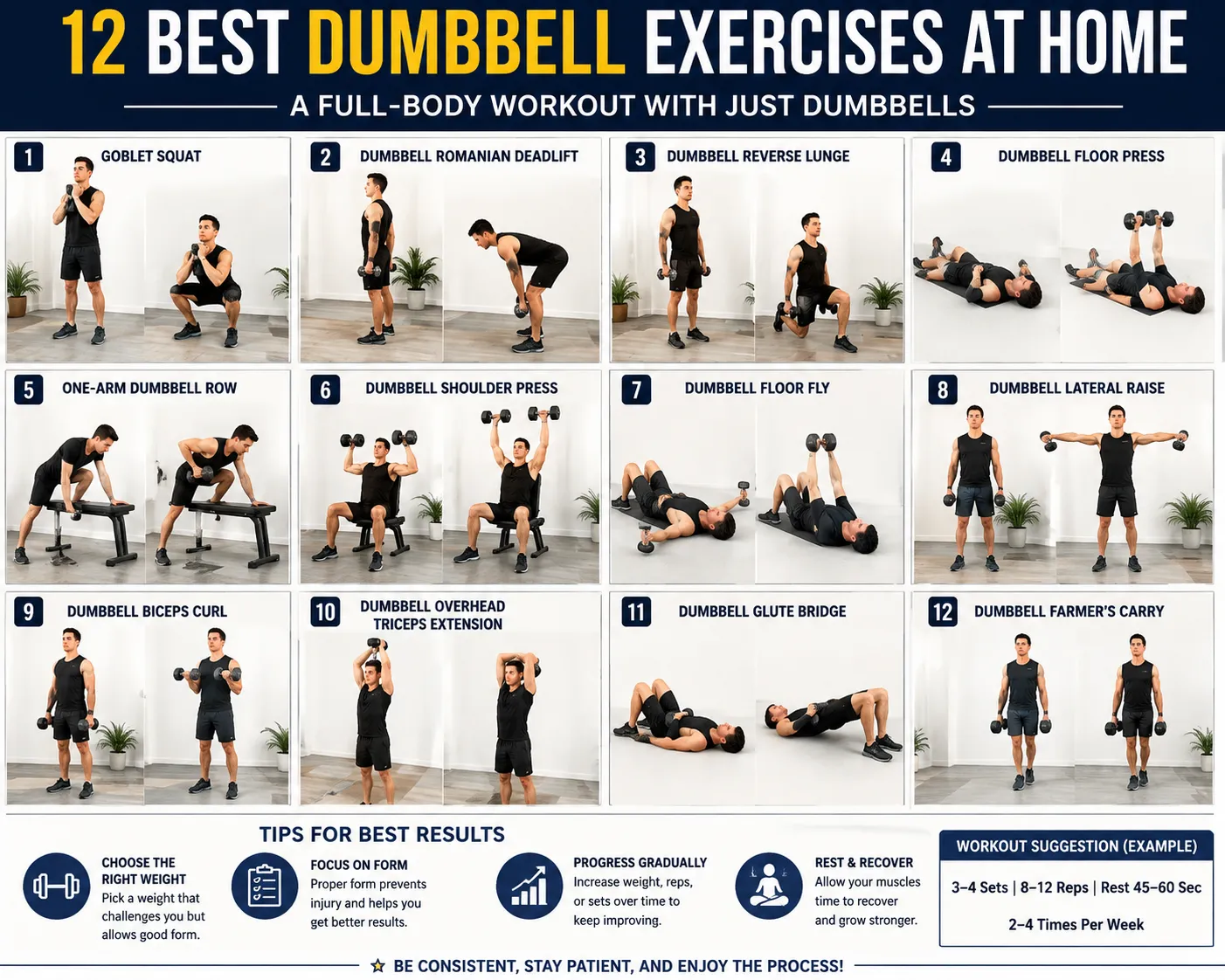
A pair of dumbbells can do a lot more than their simple appearance suggests. You don't need a room filled with machines or a dedicated home gym to work your entire body. With enough space to move comfortably, a few well-chosen dumbbell exercises can form the foundation of a solid strength routine.
The challenge is less about finding exercises and more about choosing the right combination. There are countless variations for the arms, shoulders, chest, and legs, but a long exercise list isn't necessarily a better workout. What matters is covering the major movement patterns while choosing exercises that fit your experience, equipment, and goals.
That's where the best dumbbell exercises at home come in. Some movements are especially useful because they're straightforward, versatile, and easy to adjust as you become stronger.
What Makes a Good Dumbbell Exercise?
Home workouts have one obvious limitation: you may not have much equipment. That doesn't have to be a problem.
The most useful dumbbell exercises tend to work more than one muscle group, require little setup, and give you room to progress. A good routine also has some balance to it. Squatting and hinging train the lower body in different ways, while pushing and pulling movements give the upper body a more complete workout.
Dumbbells have another advantage. Since your hands aren't locked into one bar, each side of your body has to manage its share of the load. That can make exercises such as rows, presses, and lunges particularly useful.
You don't need to chase complicated variations, either. A few familiar movements performed consistently can go a long way.
1. Goblet Squat
The goblet squat is a natural starting point for a dumbbell-based leg workout.
Hold one dumbbell in front of your chest with both hands and settle into a comfortable squat. As you lower yourself, keep the weight close to your body. Then stand back up with control.
Your quadriceps and glutes take much of the workload, while your trunk helps you stay balanced.
One reason this version works well at home is the position of the dumbbell. Keeping it close to your chest can make the squat feel stable and manageable, particularly if you're still getting comfortable with resistance training.
There's no need to force a particular depth. Your comfortable range may differ from someone else's, and control matters more than trying to reach an arbitrary position.
2. Dumbbell Romanian Deadlift
If the squat is built around lowering your body, the Romanian deadlift gives you a chance to work through a hip hinge.
Stand with the dumbbells in front of your thighs and keep a slight bend in your knees. Push your hips backward as the weights move down along your legs. Once you've reached a range you can control, bring your hips forward and return to standing.
The hamstrings and glutes are the main contributors here, while your back and core help maintain your position.
The dumbbells don't have to reach the floor. In fact, trying to go lower than your mobility allows can make the movement less controlled. A comfortable range with good technique is enough.
3. Dumbbell Reverse Lunge
Lunges bring a single-leg challenge into the workout, which changes the way your lower body and balance have to work together.
With a dumbbell in each hand, step backward with one foot and lower yourself into a comfortable lunge. Push through the front foot to come back up, then switch sides.
The backward step can feel more controlled than a forward lunge for many beginners. It also makes the exercise convenient when floor space is limited.
If two dumbbells make balancing difficult, there's nothing wrong with reducing the weight or practicing the movement without added resistance until it feels more natural.
4. Dumbbell Floor Press
No bench? You can still get a useful pressing movement.
Lie on your back with a dumbbell in each hand and press the weights upward. As you lower them, your upper arms eventually meet the floor, which naturally limits the depth of the movement.
That makes the floor press somewhat different from a dumbbell bench press, but it remains a practical option for home training.
Your chest, shoulders, and triceps share the work. Because the setup is so simple, the floor press can easily become one of the main upper-body movements in a home routine.
5. One-Arm Dumbbell Row
A home workout can quickly become push-heavy if you're not paying attention. Rows provide the pulling movement that balances things out.
Place one hand on a sturdy surface if you want extra support. With the dumbbell in your other hand, draw the weight toward your torso and then lower it under control.
Your upper and middle back do much of the work, with the biceps helping as you pull.
Try not to turn each repetition into a full-body rotation. Your torso can move naturally, but excessive twisting often means the load is harder to control than it needs to be.
6. Dumbbell Shoulder Press
The shoulder press brings an overhead movement into the routine without requiring much equipment.
Start with the dumbbells near shoulder level and press them upward. Bring them back down steadily and repeat.
A standing press asks more from your trunk because you have to stabilize yourself without a backrest. Seated presses offer more support and may feel easier to manage.
The right weight is one that lets you press without dramatically leaning backward or relying on momentum. If the movement becomes a struggle from the first repetition, reducing the load can make the exercise much more manageable.
7. Dumbbell Floor Fly
The floor fly can add another chest-focused movement, although it calls for a little more control than a press.
From a lying position, hold the dumbbells above your chest with a slight bend in your elbows. Slowly open your arms, bringing the weights outward, then return them toward the starting position.
Because you're working from the floor, the surface limits how far the weights can travel. There's no need to force a deeper stretch.
This is also a movement where lighter dumbbells can make sense. Keeping the motion controlled is more useful than trying to turn the exercise into a heavy lift.
8. Dumbbell Lateral Raise
Lateral raises are small compared with squats or deadlifts, but they can fit nicely into an upper-body routine.
Stand naturally with the dumbbells beside you. Raise your arms outward toward shoulder height, then bring them back down in a controlled manner.
The temptation here is to use more weight than you can comfortably handle. Once the dumbbells start swinging, the movement becomes something quite different from the controlled raise you intended.
A lighter load often gives you more freedom to focus on the movement itself.
9. Dumbbell Biceps Curl
The biceps curl needs almost no space, which makes it an easy addition to a home workout.
Keep the dumbbells beside your body and bend your elbows to bring them upward. Lower them again without rushing the movement.
There are several ways to vary the curl. Both arms can move together, you can alternate sides, or you can use a neutral grip for a hammer curl.
Whatever variation you choose, excessive body movement is usually a sign that the dumbbells are demanding more than you can control. Your arms should be doing most of the work rather than your entire body helping the weights along.
10. Dumbbell Overhead Triceps Extension
The triceps are easy to overlook when a workout becomes focused on curls and presses. An overhead extension gives them some direct attention.
Hold one dumbbell with both hands above your head. Bend your elbows so the weight moves behind your head, then extend your arms to bring it back up.
The overhead position doesn't suit everyone equally. If it feels uncomfortable around your shoulders or elbows, another triceps variation may be a better choice.
As with other isolation exercises, control matters more than simply choosing the heaviest dumbbell available.
11. Dumbbell Glute Bridge
For a lower-body movement that keeps you close to the floor, the glute bridge is a useful option.
Lie on your back with your knees bent and your feet planted firmly. If it feels comfortable, place a dumbbell securely across your hips and lift them from the floor. Lower yourself slowly and repeat.
The glutes are doing most of the work, with the hamstrings and trunk helping to stabilize the movement.
If adding a dumbbell makes the setup uncomfortable, there's no problem with starting without one. The basic movement can still provide a useful challenge.
12. Dumbbell Farmer's Carry
Sometimes the simplest exercises are the easiest to underestimate.
For a farmer's carry, hold a dumbbell in each hand and walk while keeping your body controlled. Your grip works continuously, while your shoulders, trunk, and legs help you stay steady as you move.
At home, you may not have much room. That's fine. A clear stretch of floor is enough for short, controlled walks, provided the area is free of obstacles and slippery surfaces.
Building These Exercises Into a Workout
The twelve exercises above aren't meant to become one giant workout.
A full-body session can be surprisingly effective with just a few movements. For instance, you could combine a squat, a hip hinge, a press, a row, and one smaller arm or shoulder exercise. That gives you plenty to work with without making the session unnecessarily long.
One possible combination is:
- Goblet squat
- Dumbbell Romanian deadlift
- Dumbbell floor press
- One-arm dumbbell row
- Dumbbell shoulder press
- Biceps curl or triceps extension
The exercises that demand the most coordination and strength can generally go earlier in the workout, while smaller movements fit naturally toward the end.
Still, there's no reason to treat that order as a strict formula. Your experience, preferences, and available equipment all influence what makes sense.
Choosing the Right Dumbbell Weight
There isn't a single “correct” dumbbell weight for everyone.
A weight that works well for goblet squats may be far too much for lateral raises. Meanwhile, the same dumbbell might feel surprisingly light during a farmer's carry.
Instead of focusing on a particular number, think about control and challenge. The resistance should be meaningful without forcing you to change the movement just to finish a repetition.
Over time, a dumbbell that once felt difficult may become much easier. That's a useful sign that your training has room to progress.
How Many Repetitions Make Sense?
Repetition ranges can vary considerably depending on the exercise, resistance, and person doing the workout.
Someone using relatively heavy dumbbells may naturally work with fewer repetitions, while lighter weights may call for more. There's no magic number that suddenly makes a set effective.
For beginners especially, learning the movement is a worthwhile priority. Once the exercise feels familiar, the amount of work can gradually become more challenging.
When Your Dumbbells Feel Too Light
Limited equipment doesn't necessarily mean limited options.
A slower lowering phase can make a familiar exercise more demanding. So can a brief pause, a single-arm or single-leg variation, or a movement that requires greater control.
Imagine that a goblet squat has become too easy with your available dumbbell. A reverse lunge could change the challenge without requiring a heavier weight.
Eventually, though, lighter equipment has its limits. If you're specifically trying to build strength, increasing resistance can become important as your ability improves.
Common Home Dumbbell Workout Mistakes
Building a Random Exercise Collection
A long list of movements can look impressive while still leaving gaps in your workout.
If you repeatedly choose exercises based on what happens to catch your attention, some muscle groups may receive plenty of work while others get very little. A basic structure helps keep the routine balanced without turning it into a rigid program.
Letting the Weight Take Over
More weight isn't automatically more productive.
Once the load causes you to swing, twist, or lose control, the exercise may no longer be challenging the intended movement in the way you want. Sometimes a lighter dumbbell produces a much better set.
Rushing Repetitions
There's no prize for finishing a set as quickly as possible.
A controlled pace gives you a better chance to notice your body position and manage the weight throughout the movement. This is especially useful when you're learning a new exercise.
Focusing Only on Pushing and Arms
Presses, curls, and shoulder raises are easy to include in a home workout. Pulling exercises such as rows can be easier to overlook.
Giving your back some attention makes the routine feel much more balanced.
Doing Too Much Too Soon
A good workout doesn't have to leave you completely exhausted.
When you're starting out, manageable sessions give you time to learn the movements and see how your body responds. You can build from there rather than trying to cram everything into the first few workouts.
How Often Can You Use Dumbbells?
There's no universal schedule that works for every person.
How often you train depends on the type of workout you're doing, your experience, recovery, and the other physical activity in your week. A full-body routine may fit comfortably into a few sessions each week, while other people may prefer dividing their training across different days.
Recovery matters too. Sleep, nutrition, everyday activity, and general stress can all influence how ready you feel for another demanding workout.
More sessions aren't automatically better if your body isn't keeping up.
A Simple Starting Workout for Beginners
If you're new to dumbbells, there's no need to build a complicated program right away.
Try a small group of movements such as:
- Goblet squat
- Dumbbell Romanian deadlift
- Dumbbell floor press
- One-arm dumbbell row
- Dumbbell shoulder press
- Biceps curl
The first few sessions are as much about learning as they are about training. Once the movements feel familiar, you can gradually increase the challenge.
There's plenty of time to make the workout more demanding later.
For More Experienced Lifters
Someone who already has experience with resistance training may want a broader session combining larger movements with more targeted exercises.
A workout might include:
Lower body: Goblet squat and Romanian deadlift
Push: Floor press and shoulder press
Pull: One-arm dumbbell row
Arms: Biceps curl and triceps extension
Loaded movement: Farmer's carry
The amount of work can vary considerably from one person to another. An experienced lifter may handle a workload that would be excessive for someone just starting out.
That's also worth considering when following workouts found online. The exercise selection can be useful inspiration, but another person's exact workload doesn't automatically make sense for you.
Choosing Exercises Around Your Goal
Your goal can influence which movements deserve more attention.
For general strength: Squats, Romanian deadlifts, presses, and rows provide a strong foundation because they involve several muscle groups.
For muscle development: Compound exercises can be paired with movements such as curls, lateral raises, and triceps extensions for more direct work.
When space is tight: Floor presses, goblet squats, rows, curls, and glute bridges are particularly convenient. A farmer's carry can work too if you have a clear path.
For beginners: Familiar movements that are easy to understand and control are usually the best place to start.
For variety: Rather than adding five exercises that feel almost identical, change the movement itself. A reverse lunge brings a different challenge from a squat, while a one-arm row changes the demands of a standard row.
When an Exercise Doesn't Feel Right
Not every exercise works equally well for every person.
A movement might feel awkward because of your experience, mobility, equipment, or simply because it doesn't suit you. That's not necessarily a problem. There are usually several ways to train the same general movement pattern.
Pain is a different matter from ordinary effort or muscle fatigue. If an exercise causes pain, stop and reconsider the movement rather than trying to force it. Persistent or concerning pain is a good reason to seek advice from a qualified healthcare professional.
Anyone managing an injury, medical condition, or significant physical limitation may benefit from individualized guidance instead of relying entirely on a general online routine.
Do You Need Adjustable Dumbbells?
No. Not necessarily.
A fixed pair can be perfectly adequate when you're getting started. Adjustable dumbbells become more appealing when you want several resistance levels without having multiple pairs taking up space.
When comparing adjustable sets, maximum weight is only one consideration. Storage, ease of changing resistance, and how comfortable the handles feel can matter just as much.
The best equipment is ultimately the equipment that suits your space, budget, and training habits.
Why Simplicity Can Be an Advantage
A workout doesn't become better simply because it contains more exercises.
One of the biggest strengths of home training is convenience. You don't have to travel to a gym, wait for equipment, or reorganize your day around a workout. When the barrier to getting started is low, consistency becomes easier.
That's why a small collection of well-chosen dumbbell exercises can be enough. Over time, what matters is how your training develops. Maybe the weights that once felt challenging now feel comfortable. Maybe your technique has become smoother. Perhaps you can handle more work without losing control.
Those changes are more meaningful than having an enormous exercise list.
How to Progress
Progress can take several forms.
Adding weight is one option, but it isn't the only one. You might become more proficient with a movement, perform additional controlled repetitions, increase the amount of training gradually, or move to a more challenging variation.
Someone who has become comfortable with a goblet squat, for example, might eventually use a heavier dumbbell. Another person may find that progressing from a basic lunge to a more demanding unilateral variation provides enough of a challenge.
The point isn't to make every workout harder than the previous one. It's to give your body an appropriate reason to keep adapting while maintaining control over the movement.
The Bottom Line
The best dumbbell exercises at home are not necessarily the flashiest ones. They're the movements that fit your space, equipment, experience, and goals while giving you a practical way to train your major muscle groups.
Goblet squats, Romanian deadlifts, reverse lunges, floor presses, rows, shoulder presses, lateral raises, curls, triceps extensions, glute bridges, and farmer's carries give you plenty of options without requiring a complicated setup.
You don't have to use all of them in one workout. Pick the movements that make sense for you, give yourself time to learn them, and let the difficulty grow gradually as your ability improves.
A couple of dumbbells sitting in a corner may not look like much. Used consistently, they can become the centerpiece of a surprisingly capable home workout.