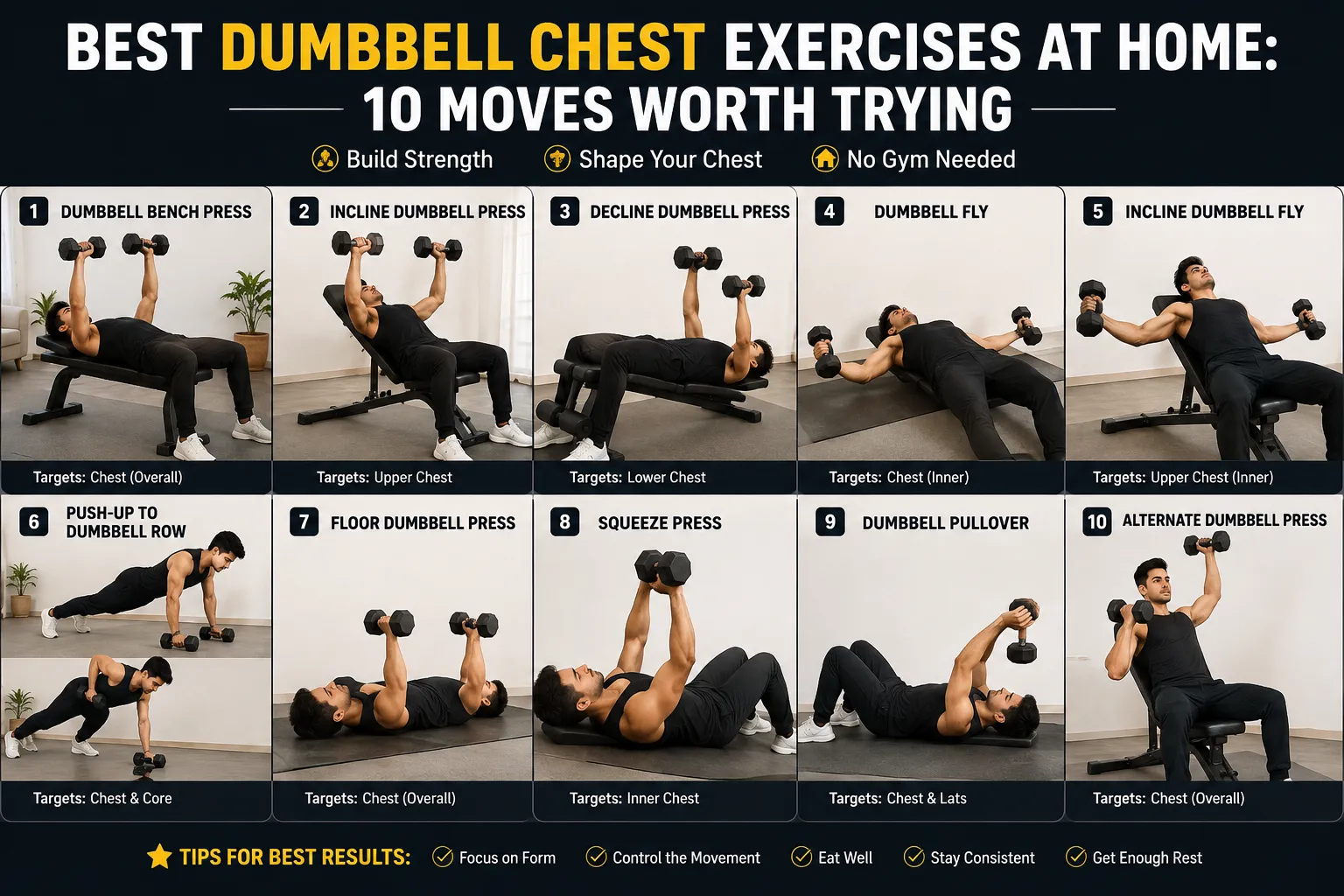
A pair of dumbbells can take you surprisingly far when it comes to chest training. You don't need a full rack of equipment or a dedicated home gym to get a productive workout; in many cases, a clear patch of floor is enough to get started.
What matters is choosing movements that do different jobs.
A press can form the foundation of the workout, while a fly or squeeze press gives you another way to challenge the chest. If you have an adjustable bench, incline pressing adds another angle. Even push-ups can earn a place in the routine when you want to finish with a bodyweight movement.
So, when people search for the best dumbbell chest exercises at home, they're really looking for a useful combination of exercises—not one magic movement that somehow does everything.
What makes a good chest exercise?
The chest isn't just involved in pushing something away from you. The pectoralis major, the large muscle across the front of the chest, also contributes when the upper arm moves across the body. The smaller pectoralis minor works around the shoulder blade.
That gives you a few different ways to approach chest training.
Presses are generally the main strength-building movements. Fly variations change the movement by keeping the elbows relatively fixed while the arms move through an arc. Adjusting the angle of a press can also shift the emphasis toward different portions of the chest.
At home, this matters because your equipment is probably limited. Rather than trying to recreate an entire commercial gym, a small selection of dumbbell movements can cover a lot of ground.
1. Dumbbell Floor Press
If you don't have a bench, start here.
Lie on your back with your knees bent and your feet comfortably planted. Hold a dumbbell in each hand above your chest. As you lower the weights, your upper arms eventually meet the floor, which naturally stops the movement before your elbows can travel very far below your torso. Press the dumbbells back up from there.
That shorter range of motion is the main difference between a floor press and a traditional bench press. It isn't necessarily a disadvantage. For home workouts, the floor gives you a stable surface and removes the need for another piece of equipment.
It's also a straightforward movement to learn. You can concentrate on keeping the dumbbells controlled instead of worrying about getting into position on a bench.
For many home lifters, that makes the floor press a strong candidate for the main exercise of the session.
2. Dumbbell Bench Press
A sturdy bench opens up another option: the dumbbell bench press.
The basic movement is familiar. The weights start above the chest, move downward under control, and return to the starting position. What makes dumbbells interesting is that your hands aren't connected by a bar, so each arm has to control its own weight.
That can make the exercise feel different from a barbell press. One side may feel stronger than the other, or you may naturally find a hand position that feels more comfortable.
The bench also permits a greater range of motion than the floor press. Whether that extra movement is useful depends on the individual, but it gives you another way to train the chest.
If you have access to a good bench and appropriate dumbbells, this is an excellent choice for the main pressing movement.
3. Incline Dumbbell Press
Sometimes changing the angle is all it takes to make a familiar exercise feel different.
An incline dumbbell press places the torso on an incline and generally shifts more emphasis toward the upper portion of the pectoralis major than a flat press. It's a useful addition when you want your chest workout to include more than one pressing angle.
Keep the incline moderate rather than turning the bench into a near-upright seat. As the angle gets steeper, the shoulders tend to take on more of the work.
This is one of those exercises where equipment makes a real difference. Without an adjustable bench, there are plenty of other choices for a home workout. With one, the incline press becomes a convenient way to add variety.
4. Dumbbell Squeeze Press
The squeeze press is particularly handy when your dumbbells aren't heavy enough to make ordinary pressing very challenging.
Lie on a bench or the floor and hold the dumbbells together above your chest. Keep them in contact as you press upward, applying gentle inward pressure. Bring them down under control while maintaining that connection.
The movement looks simple, but the inward pressure changes the sensation considerably. You're not just moving two weights up and down; you're maintaining a deliberate contraction through the chest throughout the press.
Because of that, this can be a useful accessory movement when you have limited equipment.
There's no need to squeeze the dumbbells together with maximum force. A steady, controlled pressure is enough.
5. Dumbbell Fly
The dumbbell fly takes the chest through a different movement than a press.
With a dumbbell in each hand, lie on a bench or the floor and hold the weights above your chest. Keep a small bend in your elbows as your arms open outward in an arc. Once you reach a comfortable stretch, bring the dumbbells back together.
The movement comes mainly from the shoulder rather than repeated bending and straightening of the elbows. That's also why using very heavy dumbbells isn't necessary.
A common mistake is chasing an exaggerated stretch at the bottom. More range isn't automatically more productive, particularly if your shoulders don't like that position. A controlled movement through a comfortable range is a better starting point.
For that reason, flyes tend to work nicely as an accessory rather than as the main strength movement in a chest session.
6. Dumbbell Floor Fly
No bench? You can still perform a fly variation.
The setup is much like the floor press. With your knees bent and feet on the floor, hold the dumbbells above your chest and slowly open your arms. Your upper arms eventually reach the floor, which limits how deep the movement can become. From there, bring the weights back together.
The floor changes the exercise in a useful way. You don't get the same deep bottom position as a bench fly, but you also aren't relying on a bench to control that part of the movement.
As with any fly, the dumbbells don't need to be especially heavy. Once the weights become difficult to control, the exercise can quickly turn into something other than the smooth chest movement you're aiming for.
7. Dumbbell Pullover
The pullover doesn't fit neatly into the same category as the presses and flyes.
Hold one dumbbell with both hands while lying on a bench or, if comfortable, on the floor. Starting with the weight above your chest, move it backward over your head and then return it to the starting position.
The chest participates, but so do muscles around the shoulders and upper torso. Exactly where you feel the exercise can vary from person to person, which is one reason it's better viewed as an accessory than as a must-have chest exercise.
If your shoulders don't feel good during the movement, there's little reason to force it. Your chest workout has plenty of other options.
8. Dumbbell Push-Up
Push-ups already train the chest without equipment. Holding stable dumbbells can simply give you a different hand position.
Place the dumbbells securely on the floor and grip them while setting up for a push-up. Lower your body with control, then press back up.
Some people find this position more comfortable for their wrists than placing their palms flat on the floor. The important word here is stable. If the dumbbells roll or shift easily, the setup isn't worth the added complication.
And if regular push-ups are difficult, stick with regular push-ups. A basic movement performed well is far more useful than an advanced variation that you can't control.
9. Alternating Dumbbell Press
A standard dumbbell press has both arms working at once. The alternating version changes that rhythm.
Press one dumbbell while keeping the other controlled near your chest, then switch sides. While one arm moves, the other has to maintain its position, adding a little more stability and coordination to the exercise.
It can be a good way to make moderate dumbbells feel more challenging without immediately reaching for heavier weights.
The downside is that the exercise takes longer because the repetitions are performed one side at a time. That's not a problem when you're looking for variety; it simply makes the movement different from a conventional two-arm press.
10. Neutral-Grip Dumbbell Press
Instead of facing your palms forward, turn them toward each other.
That's the main difference in a neutral-grip dumbbell press, but the change can affect how the movement feels around the shoulders and wrists. Some people find this position more comfortable, while others prefer the standard grip.
Neither version needs to be declared the universal winner. Your training doesn't become better simply because an exercise has a more impressive name.
If a neutral grip feels natural and lets you press with good control, it's a perfectly reasonable variation to keep in your routine.
How many of these exercises do you actually need?
Probably fewer than you think.
Ten exercises are useful to know about, but performing all ten in one workout would add a lot of unnecessary volume. A focused session might use one main press, one complementary chest movement, and perhaps a bodyweight exercise.
For example, you could pair the floor press with a squeeze press and finish with push-ups. If you have a bench, a flat or incline dumbbell press could take the place of the floor press, with a fly added later in the workout.
The exact combination can change as your equipment and experience change. There's no requirement to keep the same three exercises forever.
How many sets and reps should you use?
Chest training doesn't depend on one magical repetition range.
For many people, 2–4 working sets of around 6–15 repetitions is a reasonable place to begin with dumbbell pressing movements. Lighter exercises such as flyes may fit comfortably into a somewhat higher repetition range.
The weight should be challenging enough that the final repetitions require real effort, but not so heavy that you have to abandon control to finish the set.
That balance matters more than hitting a particular number.
If a set of 12 feels almost effortless and you could comfortably keep going, you may eventually benefit from more resistance or a harder variation. If your technique starts falling apart halfway through the set, going lighter makes more sense.
You also don't have to push every set until you cannot perform another repetition. Leaving some capacity in reserve can make sense, particularly when you're still learning the exercises or managing a larger training routine.
A simple home chest workout
If you want to put these exercises into practice, here's a straightforward example:
Dumbbell Floor Press — 3 sets of 8–12 reps
This is your main pressing movement.
Dumbbell Squeeze Press — 2–3 sets of 10–15 reps
The lighter, more controlled nature of this exercise makes it a useful follow-up to pressing.
Dumbbell Floor Fly — 2 sets of 10–15 reps
Keep the movement smooth and stay within a comfortable range.
Push-Ups — 2 sets
Use as many controlled repetitions as are appropriate for your current ability.
That's one possible workout, not a requirement. A beginner may find that two or three exercises are plenty, while someone with more training experience may prefer a different combination.
Rest between sets long enough to recover enough control for the next one. The amount can vary considerably depending on the exercise and how hard the previous set felt.
When your dumbbells aren't heavy enough
Limited equipment doesn't have to mean limited progress.
Eventually, you may reach a point where the dumbbells you've been using no longer make your usual sets particularly challenging. Before changing everything about the workout, look at how you're performing the exercises.
A rushed repetition can make a weight feel easier than it should. Slowing down the lowering portion and keeping the movement controlled removes some of that momentum.
Repetitions are another option. If 8 repetitions are challenging today but 12 become comfortable after several weeks, that tells you something useful about your progress.
Then there are exercise variations. An alternating press or squeeze press can change the challenge without changing the dumbbells in your hands.
Eventually, though, there is a limit to what light weights can do. If an exercise has become genuinely easy despite good technique and higher repetitions, increasing resistance may be the most straightforward next step.
Common mistakes that can make chest training less effective
Using more weight than you can control
A heavier dumbbell isn't automatically a better dumbbell.
If you have to jerk the weights into position, dramatically change your body position, or rely on momentum to complete repetitions, the resistance is probably getting in the way of the exercise.
A slightly lighter dumbbell that you can control from beginning to end is often the more useful choice.
Letting every repetition become a race
There's no rule saying every repetition has to be slow. But losing control simply to finish faster usually isn't helpful.
Pay particular attention to the lowering portion of presses and flyes. Keeping that part of the movement deliberate can make the exercise feel very different.
Taking flyes too deep
The bottom of a fly can create a noticeable stretch, which is part of what makes the exercise feel challenging. Going deeper isn't necessarily better, though.
If the position creates shoulder discomfort, shorten the range or choose another exercise. There's no reason to force a particular depth because someone else can perform it.
Making push-ups unnecessarily complicated
A push-up doesn't become more effective simply because dumbbells are involved.
If the dumbbells move beneath your hands, the added instability may create more problems than benefits. When in doubt, a regular push-up is a perfectly good choice.
Treating discomfort as something to ignore
A hard set can leave the chest and surrounding muscles tired. That's normal. Sharp, unusual, or persistent joint pain is different.
If a movement repeatedly causes discomfort, changing the resistance, range of motion, or exercise may be appropriate. For an existing injury or ongoing pain, individualized advice from a qualified healthcare or exercise professional is a safer route than trying to work around it yourself.
How often should you train your chest?
There's more than one good way to organize chest training.
It might be part of a full-body workout, included in an upper-body session, or given its own day. The right choice depends on the rest of your training and how much work you're already doing.
Someone completing several full-body workouts each week may already be training the chest often enough. Adding more chest sessions isn't automatically going to produce better results.
Recovery matters, too. If your chest is still heavily fatigued when the next workout arrives, adding more work may not be the answer.
Rather than following a fixed rule about how many times you have to train each week, look at the bigger picture: the amount of work you're doing, your progress, your other workouts, and how well you're recovering.
How to keep progressing with home chest workouts
Progress can take several forms.
Perhaps your dumbbell floor press begins at 8 controlled repetitions and eventually reaches 12 with the same weight. That is progress. Moving to a heavier dumbbell afterward is another form.
You might also improve the quality of your repetitions, become more comfortable with a full range of motion, or move from a simpler exercise to a more demanding variation.
The useful principle is gradual progression. Your workouts don't need to become harder every single time you train. What matters is that, over weeks and months, you're not stuck doing exactly the same amount of work at exactly the same level.
That can be harder to achieve when your equipment is limited, but it isn't impossible.
A beginner-friendly place to start
For someone new to dumbbell training, there's no need to build an elaborate chest routine on day one.
A floor press gives you a straightforward pressing movement. A squeeze press provides a different feel without demanding a complicated setup. Push-ups can round things out if you're comfortable with them.
Spend some time learning how each movement feels before worrying about advanced variations.
The same applies to push-ups. If a standard push-up is currently difficult, an easier variation can help you build the strength and control needed to progress. Training isn't a test of how quickly you can reach the hardest version.
Can you target the upper, lower, or inner chest?
This is where chest training advice can get unnecessarily complicated.
Different portions of the pectoralis major contribute to different movements, and changing the angle of a press can shift the emphasis. An incline dumbbell press, for example, generally places more emphasis on the upper portion than a flat press.
What you can't do is completely isolate a tiny section of the chest as if the muscle were divided into separate switches. Exercises overlap.
The same applies to the idea of burning fat from a specific part of the chest. Performing more exercises for one area doesn't cause fat to disappear specifically from that location. Fat loss is influenced by broader factors, including genetics and overall energy balance.
A balanced training routine makes more sense than chasing a special exercise for an “inner chest.”
Dumbbells vs. a barbell for home chest training
Both can be useful, but dumbbells are particularly convenient when you're working with limited space.
Because the hands aren't connected, each arm has to control its own dumbbell. That gives you some freedom to adjust your hand position and movement path.
A barbell can make sense for someone with a suitable home setup who wants to work with heavier total loads. It also requires more space and equipment.
For a smaller home gym, dumbbells often win simply because they're versatile. One adjustable pair can be used for pressing, rowing, squatting, lunging, and plenty of other exercises without taking up the room required by a full barbell setup.
Do you need a bench?
No.
A bench gives you access to flat and incline dumbbell presses, but it isn't necessary for a useful chest workout.
The floor press handles the main pressing role, while push-ups require nothing at all. Squeeze presses and floor flyes can also be performed without a bench.
If you eventually want more variety, an adjustable bench can be a worthwhile addition. It just isn't a requirement for getting started.
Choosing the right exercises for your goal
The best choice changes with the person and the situation.
For general strength, a floor press or dumbbell bench press makes a sensible foundation.
If your dumbbells are fairly light, a squeeze press, alternating press, or controlled higher-repetition work can give you more options.
For limited space, floor-based exercises and push-ups are hard to beat.
If you're new to resistance training, simple movements with an easy setup are usually more useful than complicated variations.
And if you've been training for a while, changing pressing angles or exercise variations can keep a modest home setup from becoming repetitive.
There isn't a single exercise that wins for everybody. The most useful movement is often the one that fits your equipment, feels comfortable, can be performed with control, and gives you room to progress.
Frequently asked questions
Can I build my chest with dumbbells at home?
Yes. Dumbbell presses, fly variations, and push-ups can all contribute to effective chest training without a commercial gym.
How much progress you make depends on the broader picture, including your training experience, resistance, workout structure, nutrition, recovery, and consistency.
Is the dumbbell floor press effective without a bench?
Yes. The floor press is a practical chest-pressing movement, particularly when you don't have a bench. The floor limits the range of motion compared with a bench press, but that doesn't prevent it from being useful.
Are dumbbell flyes better than presses?
They're different rather than simply better or worse.
Presses are generally easier to load heavily, while flyes offer a different movement pattern and can complement your pressing work.
How heavy should my dumbbells be?
The right weight depends on your current strength and the exercise you're performing.
A useful starting point is a resistance that makes the final repetitions challenging while still allowing you to maintain control and reasonable technique.
Can I train my chest every day?
Training the chest hard every day isn't necessary for most people.
Your overall workload and recovery matter just as much as how often the muscle is trained. Someone already doing several full-body or upper-body sessions may need less additional chest work than someone following a different schedule.
Can dumbbells target the upper chest?
Yes. An incline dumbbell press generally shifts more emphasis toward the upper portion of the pectoralis major than a flat press.
It doesn't completely isolate the upper chest, though. Other portions of the chest and surrounding muscles still contribute.
The bottom line
The best dumbbell chest exercises at home are the ones that give you useful resistance without requiring a complicated setup.
A floor press can handle the main work. An incline press adds another angle if you have a bench, while squeeze presses, flyes, and push-ups give you other ways to challenge the chest. You don't need all of them in one workout.
Choose a few movements that suit your equipment and experience, keep your repetitions controlled, and give yourself room to progress. A simple home setup can be enough to build a well-rounded chest routine—as long as the training itself keeps moving forward.