Not every day starts with enough time for a full workout. Maybe the alarm has already gone off twice, you're short on time, or the thought of getting dressed for the gym feels like too much effort. On days like these, a few minutes of movement on your bed can be a surprisingly practical place to start.
Of course, bed exercises aren't a shortcut to rapid weight loss. They simply make movement more accessible. A handful of gentle exercises can wake up your muscles, add some activity to your day, and, perhaps most usefully, make exercise feel less difficult to begin.
For weight management, though, the bigger picture matters. Your eating habits, daily activity, sleep, genetics, and overall fitness all influence the result. Bed exercises can play a supporting role rather than carrying the entire responsibility.
Can Bed Exercises Help With Weight Loss?
They can contribute to your overall activity, but their calorie-burning effect is usually modest.
Weight loss involves many factors, with long-term energy balance being one of them. Exercise increases the amount of energy your body uses, while regular physical activity also brings benefits that have little to do with calorie numbers. Strength, mobility, fitness, and simply becoming more active throughout the day all count.
That's where a short bed routine can have value.
Consider someone who spends much of the day sitting and rarely exercises. Starting with a few minutes of bridges or gentle leg movements may feel far more manageable than committing to an hour at the gym. That short session won't transform body weight on its own, but it can make regular movement easier to build into everyday life.
For someone who already has an exercise routine, these movements can serve a different purpose: a convenient option for lighter activity when a full workout isn't practical.
Why Bed Exercises Can Be Useful
Convenience is a big part of the appeal.
There is no gym commute, no special setup, and very little space involved. If those small barriers are what usually get in the way of exercise, removing them can make a difference.
A mattress also provides cushioning, which some people may find comfortable during gentle movements. The trade-off is stability. A very soft bed can make exercises that require balance or firm support more difficult.
Morning is another natural opportunity. After several hours of lying still, a few controlled movements can ease you into the day before you get up and start moving around.
And the session doesn't have to leave you exhausted. Sometimes, the useful achievement is simply getting some movement in when doing nothing would have been the easier choice.
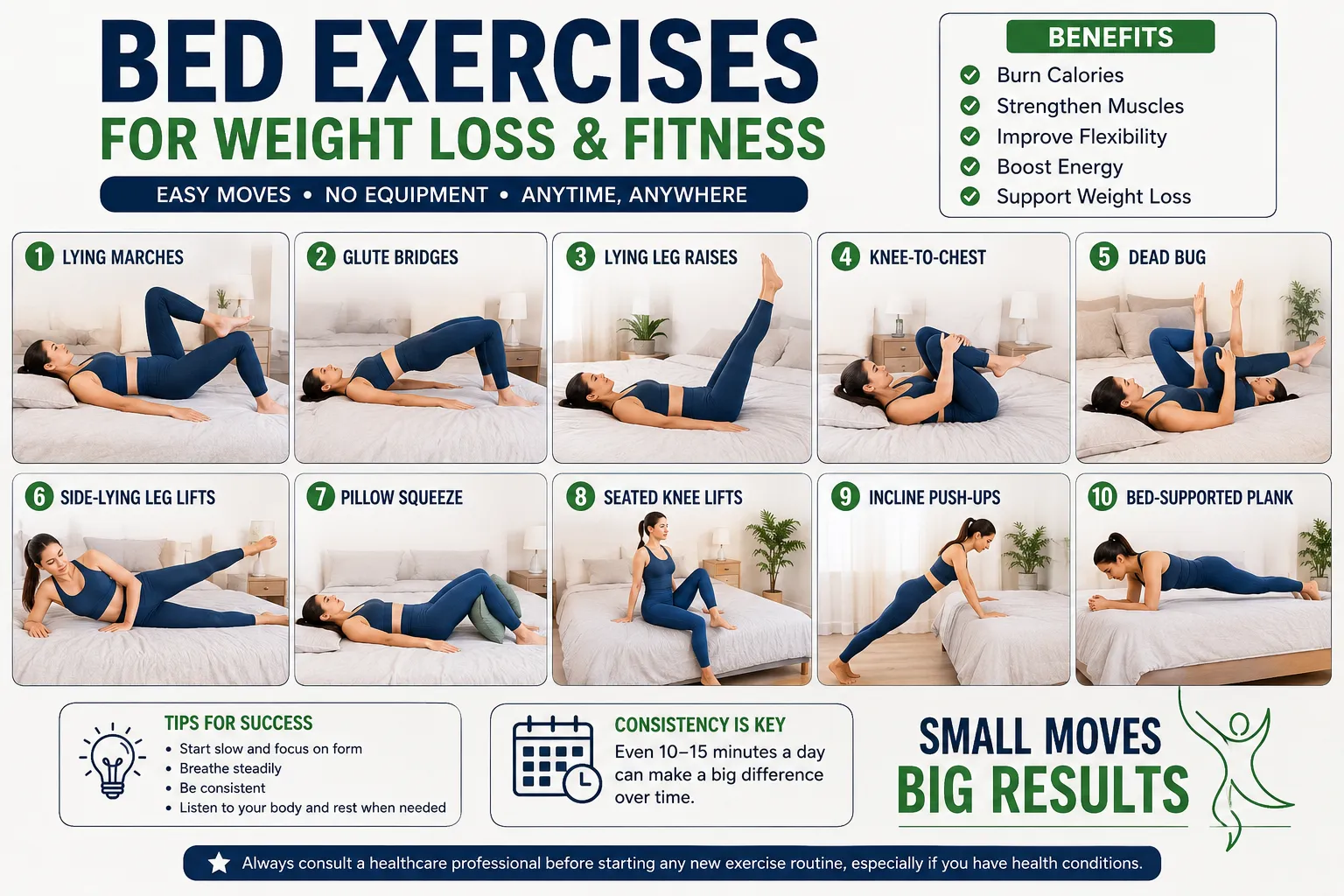
10 Bed Exercises for Weight Loss and General Fitness
These movements cover several areas of fitness, from basic core and lower-body work to simple upper-body exercises. Choose the ones that feel appropriate for you rather than treating the list as a requirement to complete from top to bottom.
1. Lying Marches
Start on your back with your knees bent and your feet resting on the mattress.
Lift one foot slightly, return it to the bed, and switch sides. Keep alternating at a comfortable rhythm.
There's nothing complicated about this movement, which makes it a useful way to ease into a session. It can also work as a brief movement break when you don't feel ready for something more demanding.
If your lower back becomes uncomfortable, make the movement smaller or move on to another exercise.
2. Glute Bridges
If you want a simple lower-body exercise that doesn't require much room, glute bridges are a good option.
Lie on your back, bend your knees, and place your feet on the mattress. With your arms resting beside you, press through your feet and raise your hips slowly. Pause briefly, then lower them with the same control.
You'll feel the work mainly around the hips and buttocks, while the core contributes to keeping your body steady.
There's no prize for lifting your hips as high as possible. A comfortable range with controlled movement is enough.
3. Lying Leg Raises
Lie on your back and extend your legs.
From there, raise your legs slowly and lower them again without letting them drop. The exercise can challenge the abdominal muscles and hip flexors.
This one deserves some caution if you tend to feel exercises in your lower back. Bending the knees slightly can make the movement more manageable, and there's nothing wrong with choosing a different exercise if it still feels uncomfortable.
The important part is maintaining control rather than trying to reach the lowest possible position.
4. Knee-to-Chest Movement
Lie comfortably on your back and bring one knee toward your chest. Return it slowly, then repeat on the other side.
The movement involves the hips and abdominal area while also giving the legs a gentle change of position after you've been lying down.
Keep the motion relaxed. The knee doesn't have to travel as far as possible for the exercise to be useful.
5. Dead Bug
The dead bug is a little more demanding from a coordination standpoint.
Lie on your back with your arms pointing upward and your knees bent and lifted. Slowly extend one arm and the opposite leg, then bring them back before changing sides.
The challenge comes from keeping your torso steady while your arms and legs move.
If the full version feels awkward, make the movement smaller. Once control improves, a larger range may feel more natural.
6. Side-Lying Leg Lifts
Turn onto one side with your legs extended.
Raise the upper leg slowly, lower it, and repeat. After working one side, turn over and give the other side the same attention.
The movement targets muscles around the hips and outer thighs. It also gives your routine some variety instead of keeping every exercise in the same position.
Try not to rock your entire body as the leg moves. A smaller lift performed steadily can be more useful than a large one that you can't control.
7. Pillow Squeeze
A pillow can turn into a simple piece of workout equipment.
Place it between your knees while lying comfortably on your back or side. Gently squeeze, hold the pressure briefly, and relax.
This isn't a high-intensity exercise, nor does it need to be. It can fit into a lighter routine when you want to engage the muscles around your hips and inner thighs without doing anything complicated.
8. Seated Knee Lifts
Now move to the edge of the bed and sit upright with your feet on the floor.
Lift one knee, lower it, and alternate between sides. Keep your upper body comfortable rather than leaning heavily from one side to the other.
Because you're sitting upright, the movement feels different from the exercises performed while lying down and adds a little more variety to the session.
If your bed is too high, unstable, or uncomfortable for this position, a sturdy chair is a better choice.
9. Incline Push-Ups
A bed can also provide an elevated surface for a modified push-up.
Place your hands on a stable part of the bed or frame and step your feet back. Bend your elbows to bring your chest toward the surface, then press away.
The height changes the difficulty. A higher surface generally makes the movement easier, while a lower stable surface can provide more challenge.
The surface needs to stay secure while you're moving. If it shifts noticeably, use a more stable setup instead.
10. Bed-Supported Plank
For a core-focused option, place your hands on a stable elevated surface and step your feet backward.
Hold a comfortable plank position while keeping your body controlled. Your core and shoulders have to work together to maintain the position.
There's no benefit in extending the hold until your form falls apart. A shorter hold that you can control is a better starting point.
A Bed Routine Doesn't Have to Be Long
You don't have to work through all ten exercises every time.
A short session might include glute bridges, lying marches, dead bugs, side-lying leg lifts, and knee-to-chest movements. Spend a few minutes moving through the exercises at a pace that feels manageable, taking breaks whenever you need them.
As the routine becomes familiar, you can gradually add repetitions, another set, or a slightly harder variation.
There's also another way to use these exercises: as a bridge to more activity. A few minutes of movement after waking up might make it easier to take a walk later, or to fit a longer workout into another part of the day.
That broader approach is often more useful than trying to make a bed workout do everything.
Morning or Evening?
There's no universal winner here. Your schedule and personal preference matter more than finding a supposedly perfect exercise hour.
Morning
A few gentle movements can be an easy way to transition from sleep to activity. Bridges, knee movements, and light leg exercises may feel especially appropriate when you're not ready for anything strenuous.
Evening
An evening session can be convenient if mornings are rushed. It may also provide a change of pace after a long day of sitting.
If more intense exercise close to bedtime seems to interfere with your sleep, keep your evening routine gentle or move harder workouts to an earlier part of the day.
The useful time to exercise is the time you're most likely to actually exercise.
How Many Calories Do Bed Exercises Burn?
It's difficult to give one meaningful calorie number because the answer changes from person to person.
The exercise itself matters, as does the length and intensity of the session. Individual differences also affect how much energy the body uses.
A few gentle movements won't burn as much energy as a longer walk, run, cycling session, or demanding strength workout. That's simply a difference in intensity, not a reason to dismiss bed exercises.
Their value can come from what they encourage beyond the session itself. If five minutes of movement helps you become more active during the rest of the day, the effect is larger than the workout's calorie count alone suggests.
Can Bed Exercises Get Rid of Belly Fat?
Not specifically.
Exercises can strengthen the abdominal muscles, but they don't let you choose exactly where the body loses fat. Doing more leg raises or abdominal exercises doesn't guarantee that fat around the stomach will disappear first.
That doesn't make core exercises pointless. Dead bugs, bridges, and controlled leg movements can still strengthen the muscles that help stabilize your body.
For changes in body fat, though, the focus needs to be broader: regular activity, eating habits, sleep, and your overall pattern of energy use all matter.
How Do Bed Exercises Compare With Regular Workouts?
It depends on the job you want the exercise to do.
A bed routine can be useful when the priority is accessibility, gentle movement, or getting started with exercise. For someone who struggles to fit activity into a busy day, that convenience has real value.
Traditional workouts offer different possibilities. Walking, cycling, swimming, resistance training, and other activities can provide a greater cardiovascular or muscular challenge and make progression easier.
The surface itself is another consideration. A mattress may feel comfortable for some exercises but can become awkward when stability is important.
Rather than treating bed exercises and regular workouts as competing choices, they can complement one another. A short bed routine might fit on one day, while a walk or strength session makes more sense on another.
Making the Exercises Harder
Progress doesn't require a complicated program.
Once a movement feels comfortable, you might add a few repetitions, spend more time under control, add another set, or try a harder variation.
Take glute bridges as an example. After regular bridges become easy to control, a stronger and more experienced exerciser might eventually experiment with a single-leg version.
There's no need to rush this process. Exercise becomes more useful when the increase in difficulty matches your ability.
If a harder variation causes pain or makes it difficult to control the movement, returning to the easier version is perfectly reasonable.
Common Problems With Bed Workouts
Expecting a Few Minutes to Transform Your Weight
A short routine can add activity to your day, but it shouldn't be treated as a standalone solution for significant weight loss.
Chasing Repetition Numbers
Doing more repetitions isn't automatically better. Once fatigue changes your technique, continuing simply to reach a target number may not be worthwhile.
Ignoring Mattress Stability
A very soft mattress can make certain movements difficult to control. Exercises involving balance or support may work better on a firmer, stable surface.
Overlooking the Rest of the Day
Your workout is only one part of your daily movement. Walking around, taking breaks from sitting, doing household activities, and spending time outdoors can all contribute.
Thinking Exercise Has to Hurt
Muscles working hard and experiencing pain aren't the same thing. Sharp, unusual, or persistent pain deserves attention rather than being treated as proof that the workout is effective.
Where Bed Exercises Fit Into Weight Management
A weight-management routine doesn't have to revolve around one particular workout.
Physical activity is only one part of the picture. Eating patterns, sleep, stress, genetics, and everyday movement can all influence how your body responds over time.
That leaves plenty of room for flexibility. You might do a short bed routine in the morning, walk later in the day, and add strength training when you have more time. Someone else may prefer a different combination entirely.
The important point is that bed exercises don't have to carry the whole plan. Their role can simply be to make movement easier to fit into your life.
Who Might Enjoy Bed Exercises?
These exercises may appeal to people who:
- Have little workout space
- Prefer gentle movement
- Are new to exercise
- Travel or spend time away from their usual workout space
- Have limited time
- Like the idea of moving soon after waking up
- Want an easy way to add more activity to the day
They can also be useful when your normal exercise routine isn't available.
Still, convenience doesn't automatically make every exercise appropriate for every person. Previous injuries, joint concerns, balance difficulties, and other health circumstances can change what feels safe and comfortable.
When to Take Extra Care
A gentle exercise routine should still be approached thoughtfully.
If you experience significant pain, dizziness, faintness, unusual shortness of breath, or another concerning symptom, stop and seek appropriate guidance. Anyone dealing with an injury, medical condition, or restriction on physical activity may want individualized advice from a qualified healthcare professional before beginning a new routine.
The same principle applies when you're unsure whether a particular movement suits your situation.
Frequently Asked Questions
Can I do bed exercises every day?
It depends on what you're doing and how your body responds. Gentle movement may fit comfortably into a daily routine, while more demanding strength exercises can require additional recovery time.
Are bed exercises suitable for beginners?
They can be. Many of these movements are easy to modify, making it possible to begin with a comfortable range and gradually build confidence and strength.
Do I need equipment?
Not really. Most of the exercises use only your body and the bed. A pillow is optional for the pillow-squeeze exercise.
Can bed exercises replace walking?
They can add useful movement, but walking offers a different kind of activity, particularly for cardiovascular fitness and general mobility. Using both can give you more variety.
Which bed exercise is best for weight loss?
There isn't a single winner. A mixture of exercises can work different muscle groups, while activities such as walking and other forms of exercise can provide additional benefits.
Should I exercise before or after breakfast?
Either can work. Your schedule, comfort, and energy levels are more relevant than trying to follow one universal rule. If exercising before breakfast makes you feel weak or uncomfortable, another time may suit you better.
Can I exercise on a very soft mattress?
Some movements may be fine, but a very soft mattress can make stability-based exercises harder. When an exercise requires firm support, a more stable surface may be preferable.
The Bottom Line
Bed exercises for weight loss aren't a miracle solution, but they can make physical activity easier to start.
That simplicity is their real advantage. When there's no gym to travel to and no complicated setup involved, a few minutes of movement can fit into moments that might otherwise be inactive.
They also work best when viewed as part of something larger. A short routine of bridges, leg movements, core exercises, or supported push-ups can complement walking, strength training, cardiovascular activity, balanced eating, and everyday movement.
You don't have to choose between a perfect workout and doing nothing. On some days, a few minutes on the bed may be exactly what gets you moving—and that can be a worthwhile place to begin.