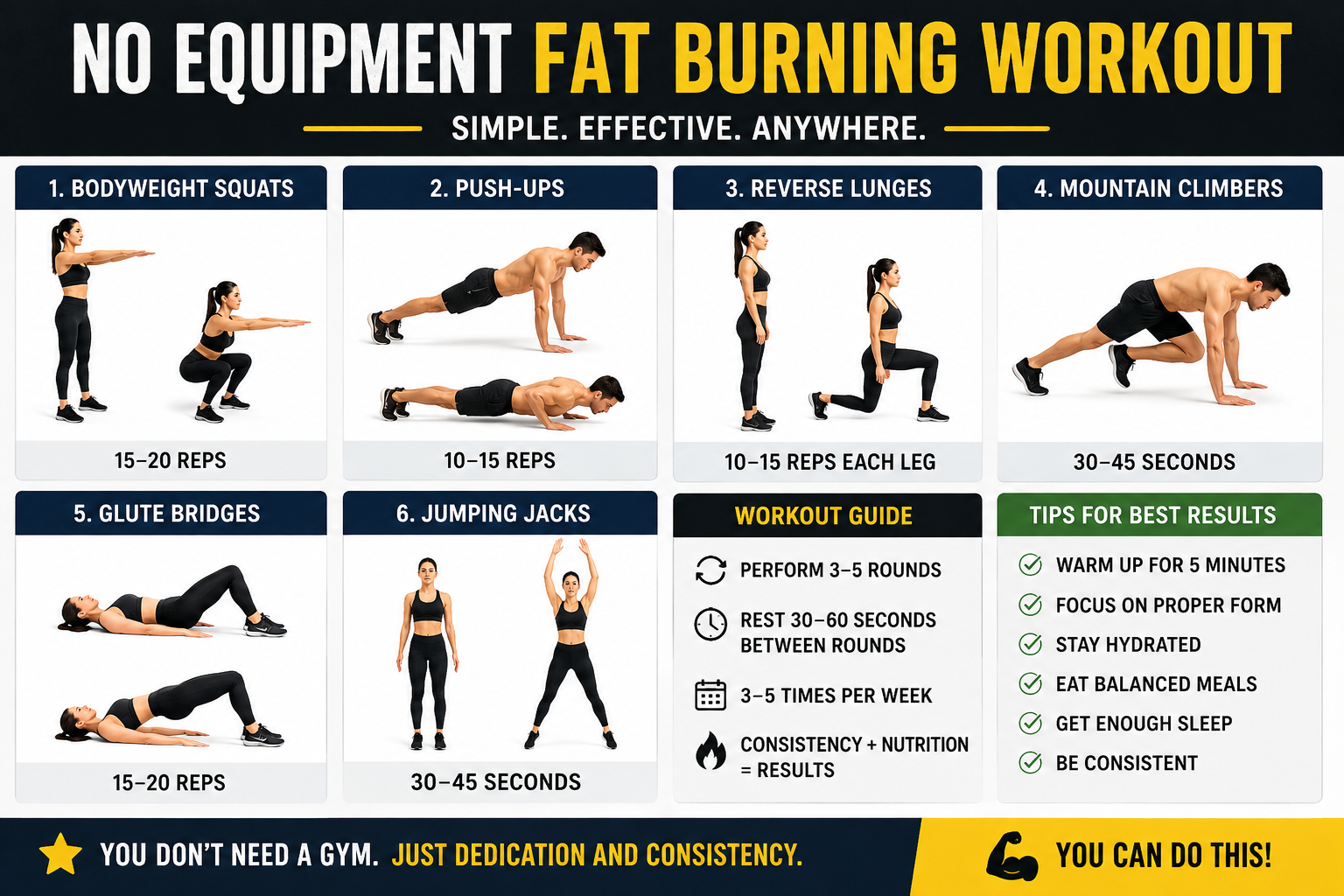
You don't need a gym full of machines to get your body moving. Sometimes, all you really need is enough floor space to stretch out your arms and take a few steps.
That makes a no equipment fat burning workout a convenient option for home, travel, or those days when getting to the gym simply isn't realistic. Bodyweight exercises can challenge your muscles, raise your heart rate, and give you a solid workout without dumbbells, resistance bands, or machines.
There is a small but important distinction, though. No workout can guarantee that you'll burn a certain amount of body fat. Changes in body fat depend on the bigger picture, including food intake, daily movement, sleep, genetics, and overall energy balance. Exercise can play an important role, but it isn't working alone.
With that in mind, bodyweight training can be a surprisingly useful part of an active routine.
Why bodyweight exercise can be challenging
Your body may not look like a piece of gym equipment, but it can provide plenty of resistance.
A squat asks your legs and hips to move your body through space. A push-up makes your upper body and core work together. Lunges add balance and coordination to the mix, while faster movements such as jumping jacks can quickly raise your heart rate.
The challenge isn't identical for everyone. A beginner may find a set of controlled squats difficult, whereas someone who has been training for years might barely notice the same movement. That's why there isn't one perfect pace, number of repetitions, or exercise combination that applies to every person.
A good workout is challenging enough to demand effort while still leaving you able to move with control.
Does a no equipment workout burn fat?
It can contribute to the energy expenditure that supports fat loss, but the process is more complicated than the phrase “fat-burning workout” suggests.
When you exercise, your body uses energy. Regular physical activity can increase the amount of energy you use throughout the day, and that can contribute to a calorie deficit when combined with suitable eating habits.
What happens during one workout, however, doesn't tell you exactly what will happen to your body over weeks or months.
For example, finishing a difficult circuit covered in sweat doesn't automatically mean you've lost a meaningful amount of body fat. Sweat mainly reflects your body's effort to regulate temperature. Likewise, the number of calories used during a workout is only one piece of the overall energy equation.
A better way to look at it is to treat exercise as part of a pattern. The workouts matter, but so do the things happening before and after them.
Exercises that work well together
You don't have to perform every bodyweight exercise you've ever seen to create a useful session. A handful of movements can cover quite a lot.
Bodyweight squats
Squats are a natural place to start because they train the lower body without requiring any equipment.
Stand with your feet around shoulder-width apart and lower your hips in a controlled motion. Your knees can follow the general direction of your toes while your chest stays in a comfortable position. Then return to standing.
The depth of the squat can vary. Someone who finds a deep squat uncomfortable may prefer a smaller range of motion while becoming more familiar with the movement.
Push-ups
Push-ups bring the upper body into the workout, working the chest, shoulders, arms, and core.
The standard version isn't the only choice. A wall push-up or elevated push-up can make the movement easier, while knee push-ups offer another way to reduce the load.
There's also little value in racing through repetitions just to reach a bigger number. Controlled movement gives you a better sense of what your body is doing.
Reverse lunges
Lunges introduce a single-leg element, which means balance and coordination become part of the exercise.
Step one foot backward, lower your body as far as feels comfortable, and return to your starting position. Then switch sides.
If balancing feels awkward at first, a nearby stable surface can provide support. There's no prize for making the movement harder than it needs to be.
Mountain climbers
Mountain climbers can bring the pace up while your shoulders, arms, and core work to keep your body stable.
They don't have to be lightning fast. Slowing the movement down can make it easier to stay controlled and may be a better choice when you're still learning the exercise.
Glute bridges
Glute bridges provide a useful change from standing movements and focus on the muscles around the hips and buttocks.
Lie on your back with your knees bent and feet on the floor. Lift your hips in a controlled movement, then lower them again.
Because there's no jumping involved, glute bridges can also balance out a routine that contains several more dynamic exercises.
Jumping jacks
Jumping jacks need very little explanation, but they're still useful when you want to raise the pace.
The jumping version isn't essential, though. Stepping one foot out at a time while moving your arms gives you a lower-impact alternative.
The point is to keep moving in a way that suits your current ability.
Putting the exercises into a short workout
A useful session doesn't have to stretch on for an hour.
For a roughly 20-minute workout, you might spend a few minutes warming up, move through several rounds of the exercises above, and then finish with some easy movement.
The exact workload can vary. Someone who is just getting started might perform fewer repetitions and pause more often. A more experienced exerciser may need longer work periods or more demanding variations.
For example, a session could move through squats, push-ups, reverse lunges, mountain climbers, glute bridges, and jumping jacks before repeating the sequence.
The clock doesn't have to control the entire workout. If your technique starts falling apart, slowing down or taking a break is a reasonable response.
When the workout starts feeling easy
At some point, your body adapts.
The workout that once left you breathing hard may eventually feel familiar. That's not a sign that bodyweight exercise has suddenly stopped being useful; it usually means you've become better at the movements.
From there, you have options.
A different exercise variation can increase the challenge. Slowing the movement, particularly during the lowering phase, can also make a familiar exercise more demanding. You might eventually add more work or shorten some recovery periods.
None of those changes has to happen all at once.
Progress tends to be easier to manage when you give your body time to adjust rather than turning every new workout into a test of how much discomfort you can tolerate.
You don't have to jump to get a hard workout
High-impact exercises often appear in fat-burning routines because they can make the heart rate climb quickly. But jumping isn't a requirement.
If jumping doesn't feel comfortable, try:
- Step jacks instead of jumping jacks
- Marching instead of running in place
- Reverse lunges instead of jumping lunges
- Controlled squats instead of squat jumps
- Slower mountain climbers instead of rapid ones
These alternatives aren't simply “easier versions” that don't count. They change the way the movement challenges you, particularly by reducing impact.
The best choice depends on your fitness level, movement experience, and comfort.
Is HIIT necessary?
Not at all.
High-intensity interval training can be performed with bodyweight exercises, and it can make a short workout demanding. A period of harder effort followed by recovery is one way to structure a session.
But there is a difference between challenging yourself and trying to make every workout brutal.
For a beginner, learning how to squat, lunge, push, and move comfortably may be more useful than immediately jumping into intense intervals. Even people with plenty of training experience need recovery.
A workout routine has room for hard days and easier ones.
Mistakes that can get in the way
Moving faster than you can control
Fast repetitions aren't automatically better repetitions.
If you have to sacrifice balance or technique to keep up with a timer, slowing down may be the smarter choice. The goal is to challenge yourself, not simply to make the exercise look intense.
Treating sweat as proof of progress
A hot room can make you sweat more than a cool one. So can certain clothing, humidity, and individual differences.
Sweat tells you that your body is managing heat. It doesn't tell you how much body fat you've lost.
Doing only fast-paced exercises
A workout made entirely of jumping jacks and mountain climbers can become tiring quickly, but tired isn't the only measure that matters.
Strength-focused movements such as squats, lunges, push-ups, and glute bridges give the session more variety and help keep the workout from becoming one long burst of cardio.
Forgetting that recovery exists
Training is only one side of the equation.
Your body also needs time to recover from demanding exercise. Sleep, food, hydration, rest, and easier forms of movement all have a place in that process.
Sometimes the most sensible decision is to make today's workout easier because yesterday's was hard.
Expecting one workout to do everything
A challenging circuit can't erase an otherwise inactive lifestyle or compensate for consistently poor eating habits and sleep.
That doesn't make exercise less valuable. It simply puts the workout in its proper context.
Long-term changes usually come from ordinary habits repeated over time, not from one exhausting session.
How often should you train?
There isn't a single schedule that everyone has to follow.
A beginner may feel better with shorter workouts and more recovery. Someone who already exercises regularly may be comfortable handling more activity.
It can also help to avoid doing exactly the same demanding workout every day. Walking, cycling, sports, mobility work, and other forms of movement can fit around bodyweight training and give different parts of your body a chance to recover.
The most useful routine is usually one you can keep doing without constantly feeling worn down.
What about belly fat?
This is where the idea of a “fat-burning” exercise can become misleading.
Doing hundreds of crunches doesn't tell your body to take fat specifically from your stomach. Fat loss doesn't happen according to the location of the muscle you're exercising.
That doesn't make core exercises pointless. Planks, mountain climbers, dead bugs, and similar movements can strengthen your midsection and improve how you control your body.
If your goal is to reduce overall body fat, the broader routine matters much more than trying to find one exercise for one area.
Starting from scratch
If you're new to exercise, there's no reason to copy an advanced workout.
You could begin with easy marching, comfortable squats, wall or elevated push-ups, supported reverse lunges, glute bridges, and slower mountain climbers.
The first few sessions are as much about learning what feels manageable as they are about building fitness. As the movements become familiar, you can gradually increase the amount of work or experiment with harder variations.
Starting slowly doesn't mean you're wasting your time. It gives you a foundation to build on.
Give yourself a proper warm-up
A warm-up can be simple.
A few minutes of easy movement can help you shift from sitting or resting into exercise. Marching in place, gentle arm movements, easy squats, and controlled leg movements are all reasonable choices.
You don't need to exhaust yourself before the actual workout begins.
If an exercise causes sharp or unusual pain, stop rather than trying to force your way through it. People dealing with an injury, medical condition, or specific health concern may want guidance from a qualified healthcare professional before changing their exercise routine.
After the workout
Recovery doesn't need to become another complicated part of your fitness routine.
A little easy walking or relaxed movement can help you wind down after a demanding session. Gentle stretching may also feel comfortable if certain muscles feel tight.
Normal meals and adequate fluids can support recovery. There's no special post-workout food that turns an ordinary bodyweight workout into a guaranteed fat-loss session.
Sometimes the simplest approach is enough: move, recover, eat normally, and get on with your day.
Where bodyweight workouts have limits
The lack of equipment is both the appeal and, eventually, one of the limitations.
For someone who is new to training, bodyweight exercises can provide plenty of challenge. As strength increases, though, adding resistance becomes more difficult when your only training tool is your own body.
That doesn't make equipment-free workouts a poor choice. They remain useful for conditioning, general fitness, movement practice, and situations where equipment simply isn't available.
They can also complement other forms of training rather than replacing everything else.
What “fat burning” really means
The phrase sounds straightforward, but your body's energy systems are anything but simple.
During exercise, the body draws energy from different sources. The balance can shift with exercise intensity, duration, nutrition, fitness, and individual physiology.
More importantly, what fuel your body uses during a particular workout isn't the same thing as your long-term change in body fat.
That distinction can take some pressure off the idea that you need to discover the single exercise that “burns the most fat.”
A more useful question is much simpler: What kind of activity can you do regularly, recover from, and realistically fit into your life?
For many people, bodyweight workouts can be part of that answer.
Frequently asked questions
Is a no equipment fat burning workout effective at home?
Yes. Bodyweight exercises can challenge major muscle groups and raise your heart rate without gym equipment. How difficult the workout feels depends on the exercises, pace, duration, fitness level, and amount of recovery.
Do I have to work out for an hour?
No. A shorter session can still be worthwhile. The amount of exercise that makes sense depends on your overall activity, fitness, goals, and ability to recover.
Is HIIT required for fat loss?
No. HIIT is simply one way to structure exercise. Walking, strength training, moderate-intensity cardio, sports, and other activities can also contribute to an active lifestyle.
Can beginners do bodyweight workouts?
Yes. Beginners can start with easier exercise variations, lower-impact movements, shorter sessions, and more recovery time. The routine can become more demanding as fitness improves.
Can bodyweight exercises build strength?
They can, particularly for beginners and people developing basic strength. Eventually, increasing resistance without equipment can become difficult, so additional training methods may become useful.
Does every workout need to be intense?
No. Hard workouts have a place, but easier sessions and recovery are important too. Constantly training at maximum effort isn't necessary for building a sustainable routine.
Can exercise alone guarantee fat loss?
No. A workout can't guarantee a particular fat-loss result. Nutrition, overall activity, sleep, genetics, health, and other individual factors all influence long-term changes in body composition.
Making an equipment-free workout work for you
The biggest strength of a no equipment fat burning workout may have less to do with fat burning itself and more to do with convenience.
You can train in a living room, hotel room, outdoor space, or another suitable area without waiting for a machine to become available or carrying equipment around with you. Squats, lunges, push-ups, glute bridges, mountain climbers, and jumping jacks can be combined in countless ways.
More importantly, the workout doesn't have to leave you completely exhausted to count.
Choose movements that match your current ability. Let the difficulty grow gradually. Give your body time to recover, and look at exercise as one part of your overall routine rather than a shortcut around everything else.
A workout you can realistically return to is far more useful than one that looks impressive on paper but doesn't fit your life.