If you've been trying to figure out how to lose arm fat, you've probably come across plenty of workouts promising to "tone" or "burn" fat from your upper arms. It sounds convincing: train the area you want to change, and eventually the fat should disappear from there.
Unfortunately, the body doesn't quite follow that plan.
Exercises such as curls, push-ups, and triceps extensions can strengthen the muscles in your arms. They can also become part of a routine that improves your overall fitness. What they can't do is tell your body to take stored fat specifically from your arms.
For most adults who want to reduce body fat, the more useful approach is broader. Regular activity, resistance training, sensible eating habits, and adequate recovery all have a place. The aim isn't to find a secret exercise for one body part, but to improve body composition over time while becoming stronger and fitter along the way.
Can you lose fat from your arms specifically?
Not reliably.
This is where the idea of spot reduction causes confusion. The theory is simple: exercise a particular muscle and the body will burn fat from the area around it. In reality, working a muscle doesn't determine where stored fat is taken from.
So doing a very large number of triceps exercises won't necessarily make your arms lose fat faster than the rest of your body.
Your muscles can still change, though. Resistance training gives them a reason to adapt and become stronger. If your overall body-fat level also decreases, those changes in muscle development may become more noticeable.
Where fat comes off first is largely individual. Genetics, hormones, age, sex, and starting body composition all influence the pattern. One person may notice changes in their arms relatively early, while another may see changes elsewhere first.
That can be frustrating if you're focused on one particular area, but it's a normal part of how body composition changes.
Why do some people carry more fat around their arms?
Fat distribution isn't identical from one person to another.
Genetics have a significant influence on where the body tends to store fat. That's why two people with similar body weights can have noticeably different shapes. One may carry more around the abdomen, while another may naturally have more around the hips, thighs, or upper arms.
Age can influence body composition as well. Muscle mass and daily activity often change over the years, which can affect the balance between muscle and fat.
Eating habits and physical activity obviously matter, but so do less visible parts of daily life, including sleep and stress. None of these factors independently explains every change in body fat. They're pieces of a much larger picture.
There isn't a particular food or exercise that overrides all of that and directs fat loss toward the arms.
The part calorie balance plays
When someone loses body fat, energy balance is part of the explanation.
A calorie deficit means that, over time, the body is receiving less energy from food and drinks than it uses. To make up the difference, it draws on stored energy, which can lead to weight loss.
That doesn't make "eat as little as possible" a good strategy.
Very aggressive restriction can leave people tired, make exercise harder, and make it difficult to get enough nutrients. It can also turn eating into a constant calculation, which isn't particularly helpful if the approach can't be maintained.
Some people prefer tracking calories because numbers give them a clear framework. Others do better by changing portions, paying attention to hunger and fullness, reducing frequent high-calorie snacks, or adjusting what they drink. There isn't one method that everyone has to use.
For example, someone who regularly drinks sugary beverages might create a meaningful change simply by choosing lower-calorie drinks more often. Another person may find that building meals around protein, vegetables, fruit, and satisfying carbohydrate sources works better.
And if you're already at a healthy weight, losing more weight isn't automatically the answer to having smaller-looking arms. In that situation, getting stronger and improving overall fitness may be a more appropriate goal.
Food choices that support the bigger goal
There is no food that specifically burns arm fat. What matters is how your eating pattern works as a whole.
Protein
Protein is useful for maintaining and repairing muscle. Foods such as eggs, fish, chicken, lean meat, milk, yogurt, beans, lentils, and tofu can all provide it.
Having some protein with meals can also make them more filling. You don't have to rely on the same source every day; variety is perfectly fine.
Carbohydrates
Carbohydrates aren't something you automatically have to remove when trying to lose body fat.
Rice, oats, potatoes, fruit, whole-grain bread, and other carbohydrate-rich foods can provide energy for exercise and everyday movement. How much fits into your diet depends on your individual energy needs and the rest of what you eat.
A food doesn't become unhealthy simply because it contains carbohydrates.
Vegetables and fruit
Vegetables and fruit bring fiber, vitamins, minerals, and plenty of variety to meals. They can also make meals more filling without requiring large portions of highly energy-dense foods.
Fresh produce is convenient for some people, while frozen options can be just as practical when time or availability is an issue.
Dietary fats
Foods such as nuts, seeds, fish, avocado, and plant oils contain fats that can fit comfortably into a balanced diet.
Because fat contains a relatively large amount of energy in a small amount of food, portions may matter when someone is trying to reduce overall energy intake. That doesn't mean dietary fat needs to disappear from the menu.
Foods you simply enjoy
A sustainable diet has room for enjoyment.
Having dessert, fried food, a burger, or another favorite food occasionally doesn't erase the value of everything else you eat. What matters more is the pattern you return to most of the time.
That tends to be easier to live with than a diet built around a long list of forbidden foods.
Where arm exercises fit in
Arm exercises are worth doing if you want stronger arms. They're just not a shortcut for targeted fat loss.
The upper body works as a unit, so a useful routine doesn't have to revolve around isolated arm movements. Pressing, pulling, and shoulder exercises train several muscles together, while curls and triceps exercises can give particular muscles some additional attention.
Push-ups
Push-ups work the chest, shoulders, and triceps while the core helps keep the body stable.
A standard push-up isn't the only version available. Someone who is still building upper-body strength might find incline push-ups more manageable, with the hands placed on a stable elevated surface.
The right variation is the one that lets you move under control rather than forcing a difficult version before you're ready.
Dumbbell rows
Rows bring some pulling work into the routine. They train the upper back and involve the biceps, making them a useful counterpoint to exercises such as push-ups.
They're also a good reminder that an arm-focused goal doesn't mean the rest of the upper body should be ignored.
Biceps curls
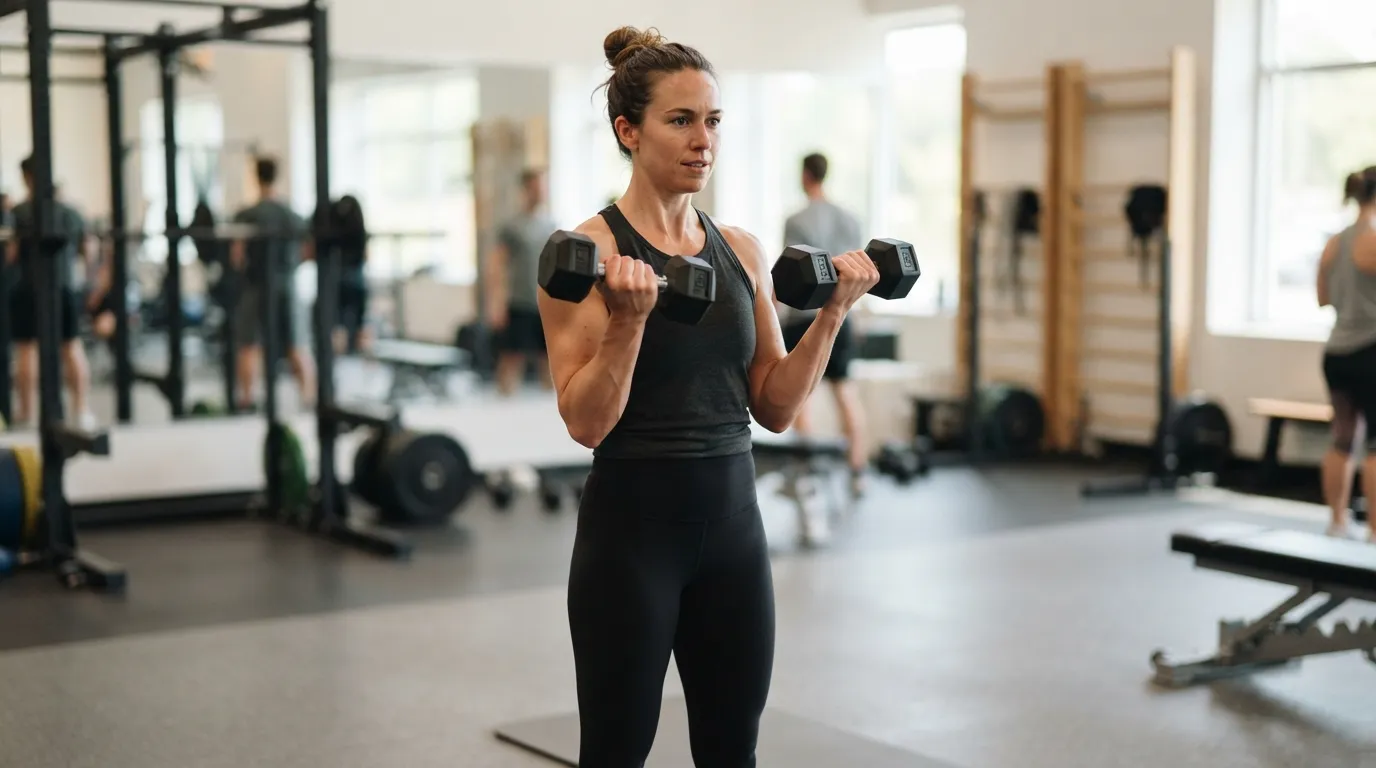
Curls are a straightforward way to train the biceps with dumbbells or resistance bands.
The exercise doesn't become more useful simply because the weight is heavier. If the resistance is so challenging that you have to swing your body through every repetition, the intended movement becomes harder to control.
Triceps extensions
The triceps make up a significant part of the upper arm, so direct triceps work can be useful when you're interested in developing that area.
Overhead extensions are one possibility, although not every exercise feels equally comfortable for every shoulder or elbow. Equipment, experience, and individual comfort all matter when choosing variations.
Shoulder presses
Shoulder presses mainly train the shoulders while also involving the triceps.
They're useful in a broader upper-body routine because they build pressing strength without turning the workout into a collection of isolated arm exercises.
Lateral raises
Lateral raises place more emphasis on the shoulder muscles. They're generally performed with lighter resistance, where smooth, controlled movement is more useful than chasing a heavy dumbbell.
Why training your whole body can be a better use of your time
It makes sense to focus on the area you're most interested in changing. But spending an entire workout on your arms isn't necessary for most people.
A full-body strength routine gives you the opportunity to train your legs, back, chest, shoulders, and arms in the same week. Exercises such as squats, lunges, rows, presses, and hip-hinge movements also build useful strength beyond appearance.
For a beginner, two or three strength sessions across the week can be a reasonable starting point. Someone with more experience, a different schedule, or additional training may prefer another arrangement.
The best routine is partly a practical decision. A theoretically perfect program isn't much help if it doesn't fit around work, family, sleep, and everything else competing for your time.
And what about cardio?
Cardiovascular exercise brings something different to the table.
Walking, cycling, swimming, jogging, dancing, and recreational sports can all increase physical activity while improving cardiovascular fitness. You don't have to choose whichever activity has the biggest calorie number attached to it.
Enjoyment matters more than people sometimes give it credit for. If walking is something you genuinely like, it can become a regular part of your week. If you prefer cycling or playing a sport, there's no reason to force yourself into an activity you dislike.
For someone who spends much of the day sitting, increasing everyday movement can also be useful. A regular walk, active hobby, or a few movement breaks can add up without feeling like another demanding workout.
Strength training and cardio don't compete for the same job. They can complement each other.
What might a realistic week look like?
There is plenty of room for individual preference, but a week could include two or three strength sessions alongside regular movement.
For example:
Monday: Full-body strength training
Tuesday: Walking, cycling, or another enjoyable activity
Wednesday: Rest or light movement
Thursday: Full-body strength training
Friday: Walking or recreational activity
Saturday: Optional strength session or active hobby
Sunday: Rest or gentle movement
That's an example, not a rule.
Someone new to exercise may start with fewer sessions. Someone already active may naturally do more. Your schedule should leave enough room for recovery and the other responsibilities in your life.
A routine that you can still follow several months from now is usually more valuable than an ambitious schedule that lasts two weeks.
How long does it take to lose arm fat?
There isn't a universal timeline.
Body-fat changes depend on the individual, and visible changes don't necessarily appear in the same order for everyone. You might notice a difference in your waist before your arms, for example, or see changes in several areas gradually rather than in one obvious place.
Your starting body composition, genetics, eating pattern, activity level, training history, sleep, and other factors all play a role.
That's why claims promising dramatic arm-fat loss in a few days deserve skepticism. A change on the scale over a short period isn't necessarily the same thing as a meaningful change in body fat, and no exercise can guarantee that a particular body part will change by a particular date.
Progress is easier to understand when you look beyond the mirror, too. Perhaps you're able to do more push-ups, use heavier resistance with good control, walk longer without getting as tired, or handle everyday tasks more comfortably.
Those are real changes, even if they aren't immediately visible.
Common mistakes worth avoiding
Turning an arm workout into a marathon
Doing more curls and triceps exercises doesn't mean your body will selectively burn more arm fat.
If most of your training time goes into one small area, you're giving up time that could be spent developing the rest of your body or simply being more active.
Treating cardio as the entire solution
Cardio can contribute to energy expenditure and cardiovascular fitness, but it doesn't replace the role of resistance training.
Strength work gives muscles a reason to adapt. That matters when the goal includes maintaining or developing muscle while body composition changes.
Cutting food too aggressively
The appeal of a crash diet is obvious: faster sounds better.
But an approach that leaves you constantly hungry, exhausted, or unable to enjoy normal meals isn't necessarily a better approach simply because the scale changes quickly.
Gradual, manageable adjustments are often easier to incorporate into ordinary life.
Looking for a supplement shortcut
The supplement market is full of products that make fat-loss claims sound simple.
There isn't a supplement that can reliably instruct your body to burn fat specifically from your arms. Claims of dramatic, targeted results should be viewed cautiously, particularly when a product suggests that ordinary nutrition and physical activity are no longer important.
Changing your workout every few days
Novelty can make exercise interesting, but constantly replacing one routine with another makes it harder to tell whether you're actually progressing.
Sticking with a sensible set of movements for long enough to learn them and gradually increase the challenge gives you something concrete to work with. Progress doesn't always mean adding a lot more weight; better control, additional repetitions, or improved confidence with the movement can matter too.
Comparing your arms with somebody else's
Bodies don't follow identical blueprints.
Two people can have similar diets, exercise routines, and body weights while carrying muscle and fat differently. Genetics, bone structure, and individual fat distribution all influence appearance.
A comparison may tell you that two bodies look different. It can't tell you that one person has discovered the perfect routine.
Will lifting weights make your arms bulky?
This concern comes up often, particularly among people who are new to resistance training.
Strength training can increase muscle size, but substantial muscular development generally takes consistent training and time. How much muscle someone gains also depends on individual factors.
For a beginner, early progress may be more noticeable in strength and coordination than in dramatic changes in muscle size. You may simply find that a movement that once felt difficult becomes easier to control.
If stronger arms are part of your goal, resistance training doesn't need to be something you avoid because you're worried about becoming excessively muscular.
Can you lose arm fat without going to a gym?
Yes.
A gym is one place to train, not the only place.
Bodyweight movements such as push-ups, squats, lunges, and planks can provide resistance. Bands can make many exercises more challenging, and dumbbells add another convenient option for movements such as rows, curls, presses, and raises.
The amount of equipment you have isn't what determines whether a workout has value.
At home, the main considerations are simple ones: enough space to move safely, stable equipment when equipment is involved, and exercises that match your current ability.
A straightforward beginner session
If you're already doing some full-body training and want a little more direct arm work, a session might include:
- Incline or standard push-ups
- Dumbbell rows
- Biceps curls
- Triceps extensions
- Lateral raises
That isn't a magic sequence, and it doesn't need to leave you completely exhausted.
Good technique and an appropriate level of resistance are more useful than turning every workout into a test of how much discomfort you can tolerate. As your experience grows, the routine can become more challenging in ways that make sense for you.
If you're completely unfamiliar with resistance training, working with a qualified fitness professional can be useful for learning technique and choosing suitable exercises.
Don't overlook sleep and stress
Food and exercise get most of the attention in fat-loss conversations, but daily life has a way of affecting both.
Adequate sleep supports recovery, energy, mood, and the ability to maintain regular habits. When sleep is consistently poor, exercise and balanced eating can become harder to manage.
Stress can create similar problems. Someone dealing with a demanding job, family responsibilities, or ongoing pressure may have less energy for meal preparation or exercise than they would under easier circumstances.
That doesn't mean stress directly causes arm fat. It means healthy habits are easier to maintain when the rest of your routine isn't constantly working against them.
Sometimes the most useful change isn't another workout. It might be making dinner easier to prepare, finding an activity you actually enjoy, or giving yourself enough time to recover.
When professional advice is worth considering
Changes in body composition are usually a normal part of life, but not every physical change should automatically be blamed on fat.
If you experience unexplained or rapid changes in body weight, unusual swelling, persistent pain, weakness, or another concerning symptom, a healthcare professional can help determine whether something else may be involved.
Professional support can also be valuable if attempts to lose weight are becoming extreme—for example, if you're heavily restricting food, exercising compulsively, or experiencing persistent distress about your body.
And if you're unsure how to perform strength exercises, particularly when dealing with an existing injury or health condition, appropriate professional guidance can help you choose safer options.
Frequently asked questions
Can arm exercises burn arm fat?
They can strengthen the muscles in your arms, but they don't selectively remove fat from that area. Where fat is lost depends on overall energy balance and individual biology.
What's the best exercise for losing arm fat?
There isn't a single exercise that targets arm fat. A combination of regular physical activity and resistance training for the arms and the rest of the body is a more realistic approach.
Will push-ups reduce arm fat?
Push-ups strengthen the chest, shoulders, and triceps. They don't determine where your body loses stored fat, although they can certainly be part of a broader fitness routine.
Do I have to stop eating carbohydrates?
No. Carbohydrates can provide energy and fit into a balanced diet. Eliminating them isn't automatically necessary for reducing body fat.
Is walking enough?
Walking is useful physical activity and can support general fitness. Whether it produces a particular body-composition change depends on your overall activity, eating pattern, starting point, and other factors.
Resistance training can complement walking by challenging the muscles in a different way.
Can you lose arm fat without weights?
Yes. Bodyweight exercises and resistance bands can provide effective resistance training. Weights are convenient, but they aren't essential.
How often should you train your arms?
There isn't one schedule that suits everyone. Beginners can often make progress with a few strength sessions spread across the week, particularly when those sessions train more than just the arms. Recovery is part of the process, so hard arm workouts every day aren't necessary.
Why aren't my arms getting smaller even though I'm exercising?
Exercise doesn't guarantee a visible change in one specific area. You might be maintaining or gaining muscle while losing fat, or your overall energy intake may not be producing the weight change you expected.
Genetics also affect where changes become noticeable, so the arms may not be the first place you see a difference.
The real answer to losing arm fat
There isn't a special workout that can persuade your body to burn only the fat stored around your arms.
What you can influence is the bigger picture: how active you are, how you train, how you eat, how well you recover, and whether the habits you're choosing actually fit your life.
If losing body fat is an appropriate goal, those foundations can support gradual changes in overall body composition. Resistance training adds another useful piece by helping you develop stronger muscles rather than focusing solely on the number on the scale.
And if fat loss isn't necessary for your health, there's still plenty of value in becoming stronger and more active.
Your arms don't have to change according to someone else's timeline or shape. A sensible routine gives your body a chance to adapt without turning the process into a race.