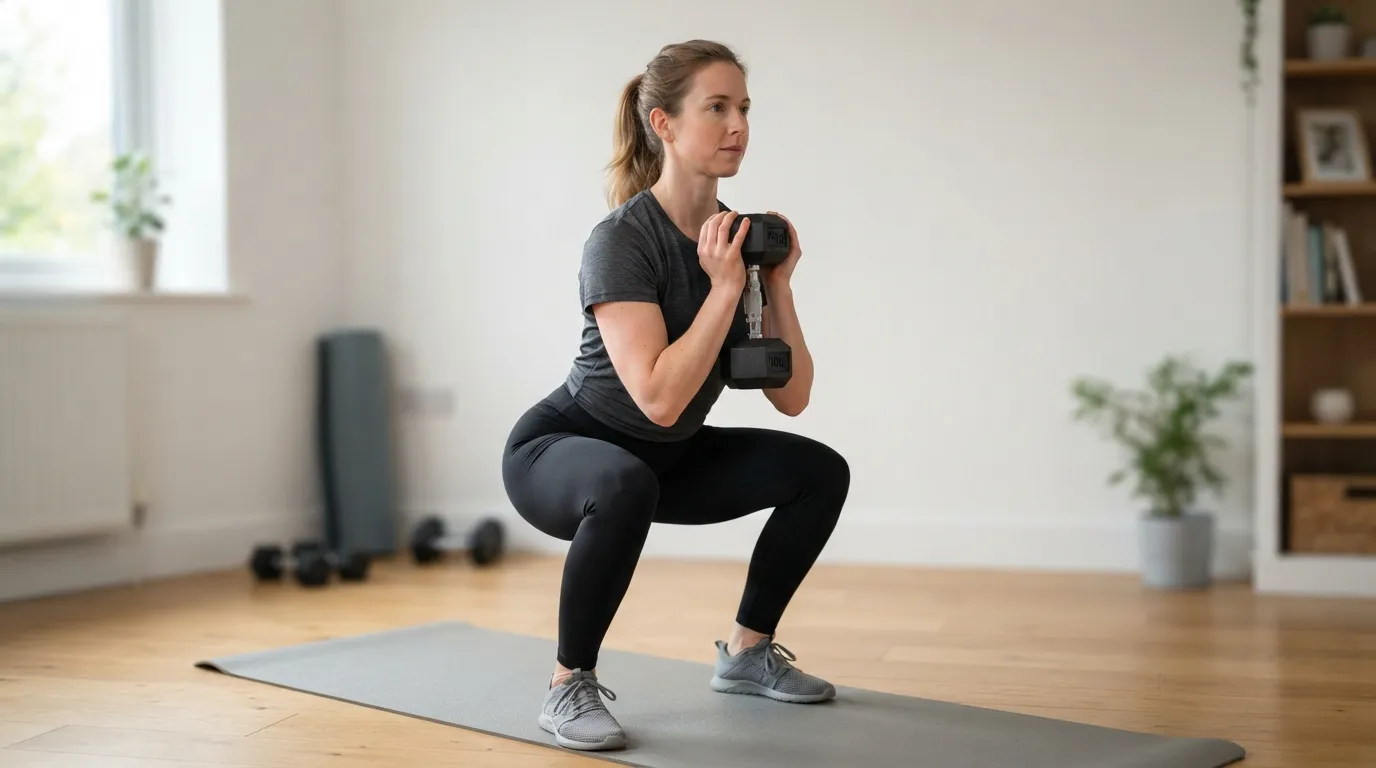
You don't need a room full of equipment to start strength training. A pair of dumbbells and a little open floor space can be enough to work your legs, chest, back, shoulders, arms, and core in the same session.
What makes a home workout useful isn't the number of exercises packed into it. It's how well those exercises work together.
For a beginner, a full-body routine should cover the basic ways your body moves without becoming so demanding that recovery turns into a problem. Squatting, hinging at the hips, pushing, pulling, and bracing the core give you a strong foundation. Once those movements become familiar, increasing the challenge becomes much easier.
If you're trying to create a full-body dumbbell workout routine for beginners at home, the following plan offers a practical place to start. It uses a pair of dumbbells, doesn't depend on a bench, and leaves enough flexibility to suit different starting points.
The workout
Three sessions a week is a reasonable starting schedule for many beginners. The workouts don't have to fall on specific days; leaving a rest day between them is more useful than forcing yourself into a particular calendar.
ExerciseSetsRepetitionsGoblet squat2–38–12Dumbbell Romanian deadlift2–38–12Dumbbell floor press2–38–12One-arm dumbbell row2–38–12 per sideDumbbell overhead press28–12Dead bug26–10 per sideOptional dumbbell curl1–210–15
For rest, around 1–2 minutes between most sets is a useful starting point. Some exercises may leave you ready sooner; others may call for more recovery. There's no benefit in hurrying simply to finish the workout faster.
If you've never lifted weights before, starting with two sets is perfectly reasonable. Once the movements feel familiar and recovery is going well, an extra set can be added where it makes sense.
Why these movements belong together
The routine covers more than individual muscles. It gives you a mix of movement patterns that complement one another.
The squat trains the legs through a knee-dominant movement, while the Romanian deadlift shifts more of the work toward the hips and the back of the legs. The floor press and overhead press provide pushing work; the one-arm row brings in a pulling movement for the upper back.
Then there's the dead bug, which adds a controlled core challenge without requiring more equipment.
The curl is deliberately optional. Your arms already contribute during rows and presses, so direct biceps work isn't necessary for the routine to count as full-body training. If you enjoy curls, though, a small amount can fit easily at the end.
That balance is more useful than collecting a long list of exercises that all do roughly the same thing.
Goblet squat
The goblet squat is a straightforward way to introduce resistance to a familiar movement.
Hold one dumbbell close to your chest with both hands. Your feet can sit around shoulder-width apart, although the most comfortable stance varies from person to person.
Bend your knees and hips as you lower into the squat. Keep the weight close and descend only as far as you can control comfortably. Then drive yourself back to standing.
There's no need to chase a particular depth just because someone else's squat looks deeper. Mobility, body proportions, previous experience, and comfort all affect how the movement looks.
Starting point: 2–3 sets of 8–12 repetitions.
A bodyweight squat is also a perfectly good substitute while you're learning the pattern or if the dumbbell you have is too heavy to hold comfortably.
Dumbbell Romanian deadlift
The Romanian deadlift is less about lowering a dumbbell toward the floor and more about learning to move from the hips.
Stand with a dumbbell in each hand. Keep a slight bend in your knees and begin sending your hips backward. As your hips travel back, the dumbbells should move down close to your legs.
Stop when you reach a comfortable range where you can still control your position. You don't have to touch the floor.
Then bring your hips forward and return to standing.
Ideally, you'll feel the exercise around your hips and the back of your legs. If most of the effort seems to be landing in your lower back, lighten the dumbbells and spend more time getting comfortable with the hinge. Individual technique can vary, so guidance from a qualified fitness professional can be useful when you're unsure.
Starting point: 2–3 sets of 8–12 repetitions.
Dumbbell floor press
A workout bench isn't essential for training your chest at home.
The floor press is a simple alternative. Lie on your back with your knees bent and your feet resting on the floor. Hold a dumbbell in each hand above your chest.
Lower the weights slowly until your upper arms make gentle contact with the floor. From there, press them back up.
Your elbows won't travel as far downward as they would during a bench press because the floor stops them. That's simply a characteristic of the exercise, not a reason to force a greater range of motion.
Starting point: 2–3 sets of 8–12 repetitions.
Keep the dumbbells under control throughout the movement. Once the set is finished, lower them safely rather than trying to sit upright quickly while holding both weights.
One-arm dumbbell row
The one-arm row gives the workout a pulling movement and provides some welcome balance to the pressing exercises.
A sturdy chair or another stable surface can provide support. Place one hand on it, hold the dumbbell in the opposite hand, and let that arm hang naturally.
From there, draw the dumbbell toward your lower ribs. Keep your torso reasonably steady and lower the weight without letting it simply drop.
The movement doesn't need a dramatic twist or swing. If your body has to generate a lot of momentum to move the dumbbell, reducing the weight will usually make the exercise easier to control.
Starting point: 2–3 sets of 8–12 repetitions on each side.
No suitable support available? A bent-over two-arm row is another option, provided you can maintain a stable position.
Dumbbell overhead press
The overhead press gives the shoulders their own pressing movement.
Begin with the dumbbells around shoulder height. Your palms can face forward or turn slightly inward, depending on what feels comfortable.
Press the weights overhead, then bring them back down under control.
The dumbbells don't have to be especially heavy for this exercise to be challenging. If a load causes you to lean noticeably backward or compensate with your whole body, a lighter option may be a better fit.
Starting point: 2 sets of 8–12 repetitions.
Some beginners find a seated version easier to control, particularly when they're still getting used to pressing overhead.
Dead bug
Core work doesn't have to mean doing endless crunches.
The dead bug challenges your ability to keep your torso steady while your arms and legs move. That makes it a useful complement to the larger strength exercises in the routine.
Lie on your back with your knees bent and lifted and your arms pointing upward. Extend one leg and the opposite arm slowly, then bring them back to the starting position before changing sides.
The movement should remain controlled. If extending an arm and leg together feels like too much, reduce the range or move one limb at a time.
Starting point: 2 sets of 6–10 repetitions per side.
Optional dumbbell curls
Curls aren't required, but they can be a nice finishing exercise if you want some direct biceps work.
With a dumbbell in each hand, bend your elbows to bring the weights upward and then lower them steadily.
The temptation here is to swing. Try not to. Once your torso starts doing most of the work, the exercise has become less about controlled elbow movement and more about generating momentum.
Starting point: 1–2 sets of 10–15 repetitions.
Finding the right dumbbell weight
There isn't a universal beginner dumbbell weight.
Your starting point depends on your current strength, previous training experience, and the exercise itself. Someone may comfortably squat with a weight that would be far too heavy for an overhead press.
A practical way to choose is to use a load that makes the last few repetitions feel challenging while your technique remains under control. You don't have to squeeze out an impossible final repetition.
Imagine you're working toward 10 repetitions. If you finish and feel as though you could easily perform another 15, the weight isn't offering much of a challenge. If you struggle to complete even the first few repetitions without your technique falling apart, it's probably too heavy.
The first couple of workouts are partly an experiment. You'll learn more about the right weights by using them than by trying to predict the perfect number beforehand.
Making the workout harder over time
Eventually, a weight that once felt difficult may become surprisingly manageable. That's a good sign.
Progress doesn't have to mean buying another set of dumbbells every week. Depending on the exercise, you can add a few repetitions, introduce another set, increase the weight, or simply become more controlled in the way you perform the movement.
For instance, suppose eight goblet squats feel challenging when you first begin. After several workouts, eight becomes comfortable and 10 feels manageable too. Working gradually toward 12 repetitions gives you another way to increase the demand before moving to a heavier dumbbell.
You don't have to change everything at once. In fact, keeping most of the routine stable makes it easier to notice what is actually improving.
Training three times a week
A Monday-Wednesday-Friday schedule is one option, but it isn't the only one.
Tuesday-Thursday-Saturday works just as well. So does another arrangement that gives you enough recovery between full-body sessions.
Three workouts can be a useful starting point for many beginners, but two sessions can also make sense when life is busy. A routine that fits your schedule is more practical than one that looks ideal on paper but rarely happens.
Full-body training also means each session covers a lot of ground. There is no need to compensate for a missed workout by cramming two sessions together.
Where cardio fits
Strength training and cardio don't have to compete for space in your week.
Walking, cycling, swimming, jogging, or another activity you enjoy can sit alongside your dumbbell sessions. How much cardio makes sense depends on what you're trying to achieve, how active you already are, and how well you recover.
If you're relatively inactive, regular walking may be a simple way to increase your overall activity without making every day feel like a training day.
When strength is the main focus of a particular session, doing the dumbbell work before a long or demanding cardio session can make sense. An easy warm-up beforehand is different; a few minutes of light movement can help you ease into the workout.
How long does the workout take?
There's no requirement for a beginner workout to last an hour or more.
With a short warm-up, several exercises, and normal rest periods, this routine will often fit into roughly 30–50 minutes. The actual time depends on how many sets you perform, how quickly you move between exercises, and how much rest you personally need.
If you need an extra minute before the next set, take it. Finishing five minutes earlier isn't particularly useful if the quality of the last few exercises has suffered because you were rushing.
Mistakes that are easy to make
Going too heavy too soon
It's tempting to choose a dumbbell based on what you think you ought to lift.
That usually isn't necessary. Beginners have plenty of opportunity to make progress, and a manageable weight gives you room to learn the movements instead of fighting the equipment.
Treating every set like a test
A workout can be challenging without every set becoming an all-out effort.
When you're still learning an exercise, leaving some room before you reach your absolute limit can make it easier to keep your technique consistent. It also tends to make the next workout less intimidating.
Adding exercises just because they're available
Once you discover home-workout videos and exercise lists, it's easy to keep adding movements.
But if your routine already includes a squat, hinge, push, pull, and core exercise, you're covering the essentials. More isn't automatically better.
Extra exercises make more sense when they have a reason for being there.
Forgetting the lower body
Upper-body exercises are easy to notice because you can see them in the mirror. That can make it tempting to spend most of your time on presses and curls.
The legs and hips deserve equal attention in a full-body routine. That's why the squat and Romanian deadlift aren't optional background exercises here.
Moving too quickly
A fast repetition isn't necessarily a bad repetition. The problem comes when speed replaces control.
Especially while learning, taking enough time to feel where the weight is going can make the exercise easier to understand and repeat consistently.
Changing everything every week
New exercises can be fun, but constant change makes progress harder to judge.
If the same goblet squat feels easier after several weeks, or you can row the same dumbbell for more controlled repetitions, you've gained useful information. Keeping the basic movements around for a while gives you something to compare.
When an exercise doesn't feel right
Not every exercise works equally well for every person.
A goblet squat may feel awkward because of mobility or simply because you're new to the position. Bodyweight squats can give you time to practice. An overhead press might feel more comfortable seated. A one-arm row may work better with a different support position.
Modification isn't a failure of the program. It's part of making the program fit the person using it.
There's also a useful distinction between effort and pain. Muscles becoming tired and breathing harder during exercise can be normal. Sharp, sudden, or persistent pain is different and deserves attention rather than being pushed through.
If you're dealing with an injury or a health condition that could affect exercise, individual guidance from an appropriate healthcare professional or qualified fitness professional may be worthwhile before beginning a new program.
What to do on rest days
A rest day doesn't have to mean complete inactivity.
An easy walk, normal daily movement, or gentle mobility work can fit comfortably between strength sessions, provided it doesn't interfere with recovery.
Sleep and food matter here as well. Exercise is the stimulus, but recovery depends on more than what happens while you're holding the dumbbells. Your body still needs enough food, fluids, and rest.
You don't need a complicated supplement routine to begin strength training. A balanced diet that provides enough energy and protein is a more useful foundation for most people.
A four-week starting approach
There's no need to overhaul the routine every seven days. A little patience gives you time to learn what the exercises actually feel like.
Week 1: Learn the movements
Keep the weights manageable and concentrate on becoming comfortable with the exercises. For someone completely new to resistance training, two sets of most movements can be enough.
Week 2: Let the routine settle
Keep the same exercises and, where appropriate, gradually move toward the higher end of the repetition ranges.
The goal isn't to force progress. It's to become more familiar with the movements while paying attention to how your body responds.
Week 3: Add a little more
If certain exercises now feel comfortable, an additional set or a modest increase in weight may be appropriate.
There's no reason every exercise has to progress simultaneously. One movement may be ready for more resistance while another still feels challenging.
Week 4: Take stock
Look beyond the numbers.
Maybe the dumbbells are the same, but your squats feel steadier. Perhaps you can complete more repetitions without losing control. Maybe the workout itself no longer feels unfamiliar.
Those changes matter. Strength training is partly about becoming better at the movements, not simply chasing heavier weights.
After four weeks, you can continue with the same basic routine or make small adjustments based on what you've learned.
If you only have one dumbbell
One dumbbell can still cover a lot.
Goblet squats and Romanian deadlifts work with a single weight. Rows and presses can be performed one side at a time, while the dead bug doesn't require equipment at all.
There is one obvious trade-off: unilateral exercises take longer because each side gets its own turn. The upside is that you don't need a matching pair of dumbbells to train effectively.
If you have adjustable dumbbells
Adjustable dumbbells make changing resistance more convenient, particularly as your strength develops.
They can also be useful because different exercises rarely call for exactly the same load. Your squat and row may eventually use considerably more resistance than your overhead press.
Having the option to add weight doesn't mean you have to use it every workout. A heavier setting is most useful when the current load has become manageable and your technique remains solid.
How to tell whether you're making progress
Progress can be easy to miss when you're looking only for visible changes.
Maybe a dumbbell that once felt awkward now feels familiar. Maybe you're completing more repetitions with the same weight, or your movement is steadier than it was during the first week.
Those are genuine signs of improvement.
Visible physical changes vary considerably from person to person, and they don't follow a universal timetable. A beginner program is better judged by what you can gradually do and control than by promises about how your body will look after a fixed number of weeks.
Frequently asked questions
Can beginners do a full-body dumbbell workout at home?
Yes. A pair of dumbbells can provide enough resistance for a basic full-body routine. Squats, Romanian deadlifts, rows, presses, and core exercises cover a broad range of movement patterns without requiring a traditional gym setup.
Is three days a week enough?
For many beginners, three non-consecutive sessions are a practical starting point. Two sessions can also work if that's what your schedule allows.
What matters is that the routine remains manageable and that you have enough time to recover between sessions.
Do I need to exercise every day?
No. Full-body resistance training doesn't have to be a daily activity.
Rest days give you time away from demanding strength sessions. Light movement such as walking can still be part of those days if it feels comfortable.
Should cardio come before or after dumbbell training?
It depends on your priorities and the intensity of the cardio.
If strength training is the main focus, doing the dumbbell workout before a longer or harder cardio session may make sense. A short, easy warm-up beforehand is completely different from tiring yourself out with a demanding cardio workout.
Can light dumbbells build strength?
They can provide a useful challenge, particularly for someone who is new to resistance training. As your strength develops, though, the same weights may eventually become less challenging, at which point another form of progression can become useful.
Do I need a bench?
No. The floor press provides a chest-pressing option without a bench, while rows can be done with suitable support.
A bench gives you additional exercise choices, but it isn't necessary for this particular beginner routine.
What if I miss a workout?
Just return to your regular schedule when you can.
Trying to squeeze a missed session into the next workout usually isn't necessary. One missed day is much less important than having a routine you can return to consistently.
Keep the beginning simple
A good home dumbbell routine doesn't need to look impressive.
Two dumbbells, a little space, and a handful of movements can cover most of what a beginner needs from a basic full-body strength session. The first few weeks are less about finding the hardest possible workout and more about learning how your body moves under resistance.
Once the exercises become familiar, progression becomes easier to judge. You can add a little weight, work through more repetitions, or simply perform the same movements with greater control.
That's enough. A routine becomes useful when you can actually live with it—week after week, without feeling as though every workout has to be an event.